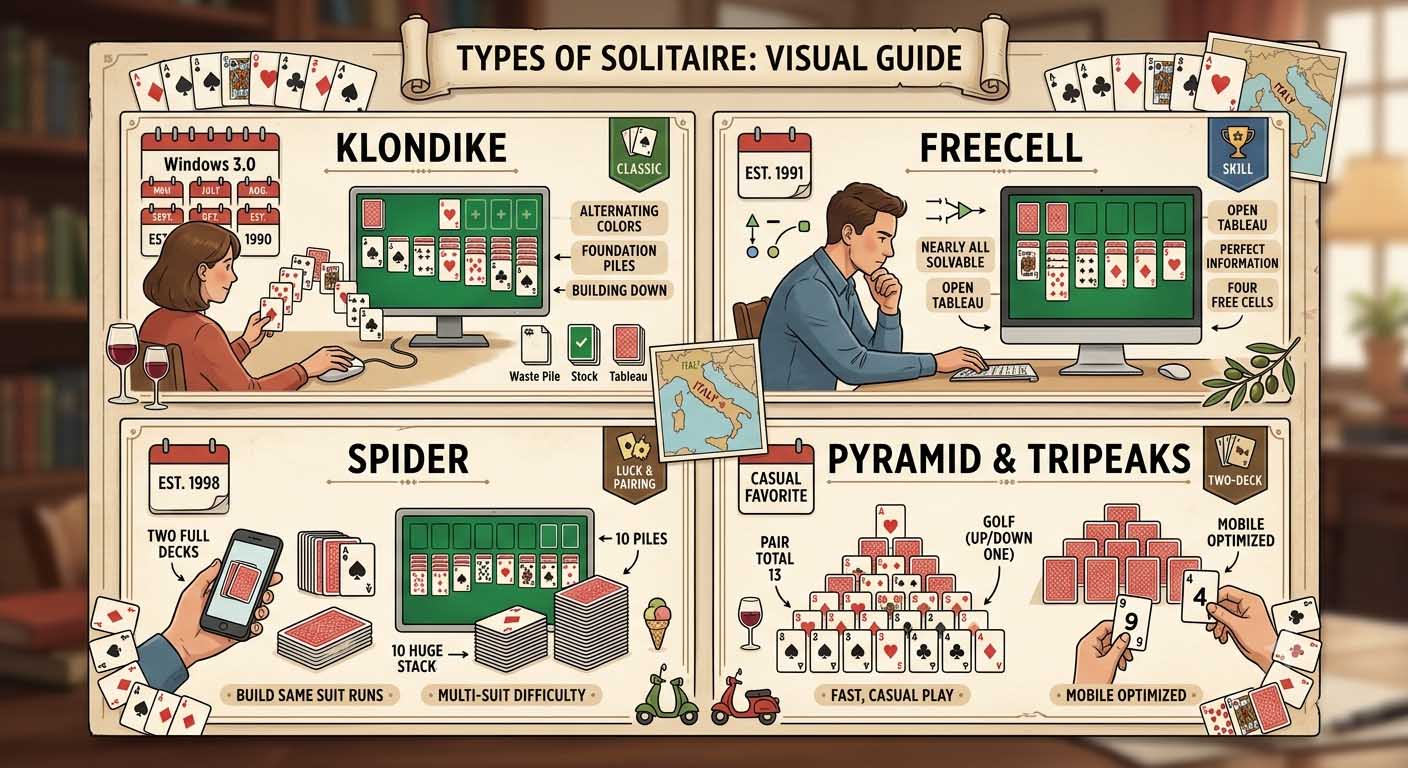
Think solitaire is just one game? Think again. While many people know the classic version that came pre-installed on older computers, solitaire is actually a family of hundreds of card games. Each variation has its own layout, rules, and level of difficulty. In particular, some focus on careful planning, while others rely more on luck. If you’re curious about the different ways to play, this guide explores the most popular types of solitaire, explains how they work, and helps you decide which version matches your playing style.
Quick Comparison of Popular Solitaire Games
| Solitaire Game | Difficulty | Best For | Skill vs Luck |
|---|---|---|---|
| Klondike | Easy | Beginners | Balanced |
| Spider | Medium | Strategy lovers | Mostly Skill |
| FreeCell | Medium | Puzzle fans | Mostly Skill |
| Pyramid | Medium | Casual players | Balanced |
| TriPeaks | Easy | Quick games | Balanced |
| Yukon | Hard | Experienced players | Skill |
| Golf | Easy | Fast gameplay | Luck and Skill |
| Canfield | Hard | Challenge seekers | Higher Luck |
| Forty Thieves | Hard | Advanced players | Skill |
| Scorpion | Hard | Strategic players | Mostly Skill |
What Is Solitaire?
Solitaire is a card game designed for one player, combining strategy, planning, and patience as players arrange cards according to specific rules to complete the game successfully.
Although the goal varies depending on the version, most games require moving cards into a specific order while following suit and rank rules.
Moreover, although physical cards are still popular, digital versions have introduced millions of players to solitaire through computers, smartphones, and tablets.
Different Types of Solitaire
Although there are hundreds of solitaire variants, a handful remain the most popular.
Therefore, here are the games you’ll encounter most often.
Klondike Solitaire
Klondike is the version most people simply call “Solitaire” because it is the classic variation that has been included on personal computers and digital devices for decades, making it the most widely recognized and frequently played form of the game.
Objective:
Move every card into four foundation piles sorted by suit from Ace to King.
Why players enjoy it:
- Easy to learn
- Balanced difficulty
- Great for beginners
- Available on nearly every platform
Overall, this remains one of the best starting points for new players.
Spider Solitaire
Spider Solitaire is one of the most popular alternatives to classic Solitaire, offering more complex gameplay, increased strategic depth, and multiple difficulty levels that appeal to both casual and experienced players.
Instead of building foundations by suit, players create complete sequences from King to Ace.
Most digital versions offer:
- One Suit (Easy)
- Two Suit (Medium)
- Four Suit (Hard)
In particular, Four Suit Spider is considered one of the toughest mainstream solitaire games.
FreeCell Solitaire
FreeCell stands out because nearly every game can be solved with perfect play.
Features include:
- Four free storage cells
- Minimal luck
- Heavy strategic planning
Therefore, players who enjoy puzzle-solving often prefer FreeCell over Klondike. Similarly, they may enjoy exploring other types of puzzles.
Pyramid Solitaire
Pyramid Solitaire uses a unique triangular layout.
In this version, cards are removed by matching pairs that total 13.
Examples:
- Ace + Queen
- Two + Jack
- Six + Seven
- King alone
As a result, games move quickly, making Pyramid a favorite for casual sessions.
TriPeaks Solitaire
TriPeaks features three overlapping card pyramids.
In particular, players remove cards one value higher or lower than the active card.
Therefore, its fast pace makes it one of the most relaxing solitaire variants.
Golf Solitaire
Golf Solitaire is simple to learn.
Specifically, players remove cards one rank above or below the current card without worrying about suits.
As a result, games typically finish in only a few minutes. Likewise, players interested in fast card gameplay may enjoy learning how to play speed.
Yukon Solitaire
Yukon shares similarities with Klondike but removes the stock pile.
However, players may move entire stacks even when some cards remain face down.
Therefore, planning several moves ahead becomes essential.
Forty Thieves Solitaire
Forty Thieves uses:
- Two decks
- Ten tableau piles
- Eight foundation piles
Therefore, winning requires patience and careful planning.
In fact, many experienced players consider it one of the toughest classic solitaire games.
Canfield Solitaire
Canfield has a reputation for difficulty.
Features include:
- Small reserve pile
- Limited movement
- Challenging layout
Therefore, don’t expect to win every game.
Scorpion Solitaire
Scorpion combines ideas from Spider and Yukon.
As a result, it rewards players who enjoy planning complex card movements.
Although challenging at first, experienced players often find it highly satisfying.
Different Types of Solitaire Games by Difficulty
Not every solitaire game offers the same challenge.
Beginner-Friendly Solitaire Games
Generally, these games are easy to learn.
- Klondike
- TriPeaks
- Golf
- Pyramid
Perfect for:
- New players
- Casual gaming
- Short play sessions
Intermediate Solitaire Games
Meanwhile, players ready for more strategy may enjoy:
- Spider (One Suit)
- Spider (Two Suit)
- FreeCell
- Yukon
Overall, these versions require better planning while remaining approachable.
Advanced Solitaire Games
Experienced players often choose:
- Spider (Four Suit)
- Forty Thieves
- Canfield
- Scorpion
Ultimately, winning consistently requires practice and careful decision-making.
Types of Solitaire Card Games Ranked by Strategy
If you enjoy thinking several moves ahead, these games emphasize skill.
| Rank | Game | Strategy Level |
|---|---|---|
| 1 | FreeCell | ★★★★★ |
| 2 | Spider (4 Suit) | ★★★★★ |
| 3 | Forty Thieves | ★★★★★ |
| 4 | Yukon | ★★★★☆ |
| 5 | Klondike | ★★★★☆ |
| 6 | Pyramid | ★★★☆☆ |
| 7 | Golf | ★★☆☆☆ |
Types of Solitaire Games for Beginners
Starting with the easiest games helps you build confidence.
Recommended order:
- Klondike
- TriPeaks
- Pyramid
- Golf
- Spider (One Suit)
- FreeCell
Once you’re comfortable, move to more advanced versions.
Different Types of Solitaire Games Available Online
Modern gaming platforms include dozens of solitaire variations.
Popular options often include:
- Daily challenges
- Timed modes
- Unlimited undo
- Achievement systems
- Statistics tracking
- Custom card designs
- Hint systems
As a result, these features make digital solitaire more accessible than traditional card decks.
Best Tips for Winning Solitaire More Often
Although luck plays a role in some versions, making smart decisions and using effective strategies can significantly improve your chances of achieving better results over time.
Reveal Hidden Cards Early
Whenever possible, uncover face-down cards.
As a result, more available cards create more options.
Don’t Rush Foundation Moves
Moving cards to the foundation immediately isn’t always the best strategy.
In fact, sometimes keeping them available helps create better sequences.
Empty Columns Carefully
An empty tableau column gives valuable flexibility.
Therefore, try to create one when possible.
Think Several Moves Ahead
Before making a move, ask yourself:
- Will this reveal a hidden card?
- Does it block future moves?
- Can I improve the tableau instead?
Ultimately, planning ahead often separates experienced players from beginners.
Common Beginner Mistakes in Solitaire
Using Hints Too Often
Hints solve immediate problems but don’t always teach good strategy.
Therefore, try solving puzzles yourself first.
Ignoring Card Order
Building random stacks usually creates dead ends later.
For this reason, follow the game’s rules carefully.
Restarting Too Quickly
Although many games look difficult, they remain winnable.
Therefore, take another look before giving up.
Playing Too Fast
Solitaire rewards careful observation.
As a result, slowing down often leads to better decisions.
Physical Cards vs Digital Solitaire
Both versions offer unique advantages.
Physical Cards
Pros:
- Traditional experience
- No screen required
- Great for travel
Cons:
- Takes longer to set up
- Limited statistics
Additionally, players who prefer traditional card play may also enjoy the hand and foot card game.
Digital Solitaire
Pros:
- Instant games
- Automatic shuffling
- Undo button
- Daily challenges
- Progress tracking
Cons:
- Requires a device
- Some versions include ads
Overall, many players enjoy both depending on the situation, choosing the option that best fits their goals, preferred strategy, or the specific challenges they face during gameplay.
Why Solitaire Remains Popular
Solitaire has remained popular for generations because it offers:
- Relaxing gameplay
- Mental exercise
- Flexible game length
- Easy rules
- Endless replay value
Unlike many competitive games, solitaire lets players improve at their own pace.
Frequently Asked Questions About Solitaire
Which Solitaire Game Is the Most Popular?
Klondike remains the world’s most recognized solitaire game thanks to its inclusion on early personal computers.
Which Solitaire Game Is Hardest?
Spider (Four Suit), Forty Thieves, and Canfield are widely considered among the most difficult variants.
Which Solitaire Game Depends Least on Luck?
FreeCell is famous because nearly every deal can be solved through careful planning.
Is Spider Harder Than Klondike?
Yes. In particular, Spider Solitaire generally requires more strategic thinking, especially the Four Suit version.
How Many Types of Solitaire Games Exist?
There are hundreds of solitaire variations, with new versions still being created by developers and card game enthusiasts.
Which Solitaire Game Should You Try First?
If you’re new to solitaire, Klondike is the perfect starting point thanks to its simple rules and balanced gameplay. Once you’ve mastered the basics, you can explore different types of solitaire such as Spider, FreeCell, Pyramid, and TriPeaks to discover new challenges and strategies.
Whether you’re interested in learning about different types of solitaire games, comparing types of solitaire card games, or simply looking for enjoyable types of solitaire games to play during your free time, there’s a version for every skill level. Some reward careful planning, while others offer quick and relaxing rounds, and many provide endless replay value. Therefore, try a few different styles, experiment with new strategies, and you’ll soon find the solitaire game that keeps you coming back for one more round.