
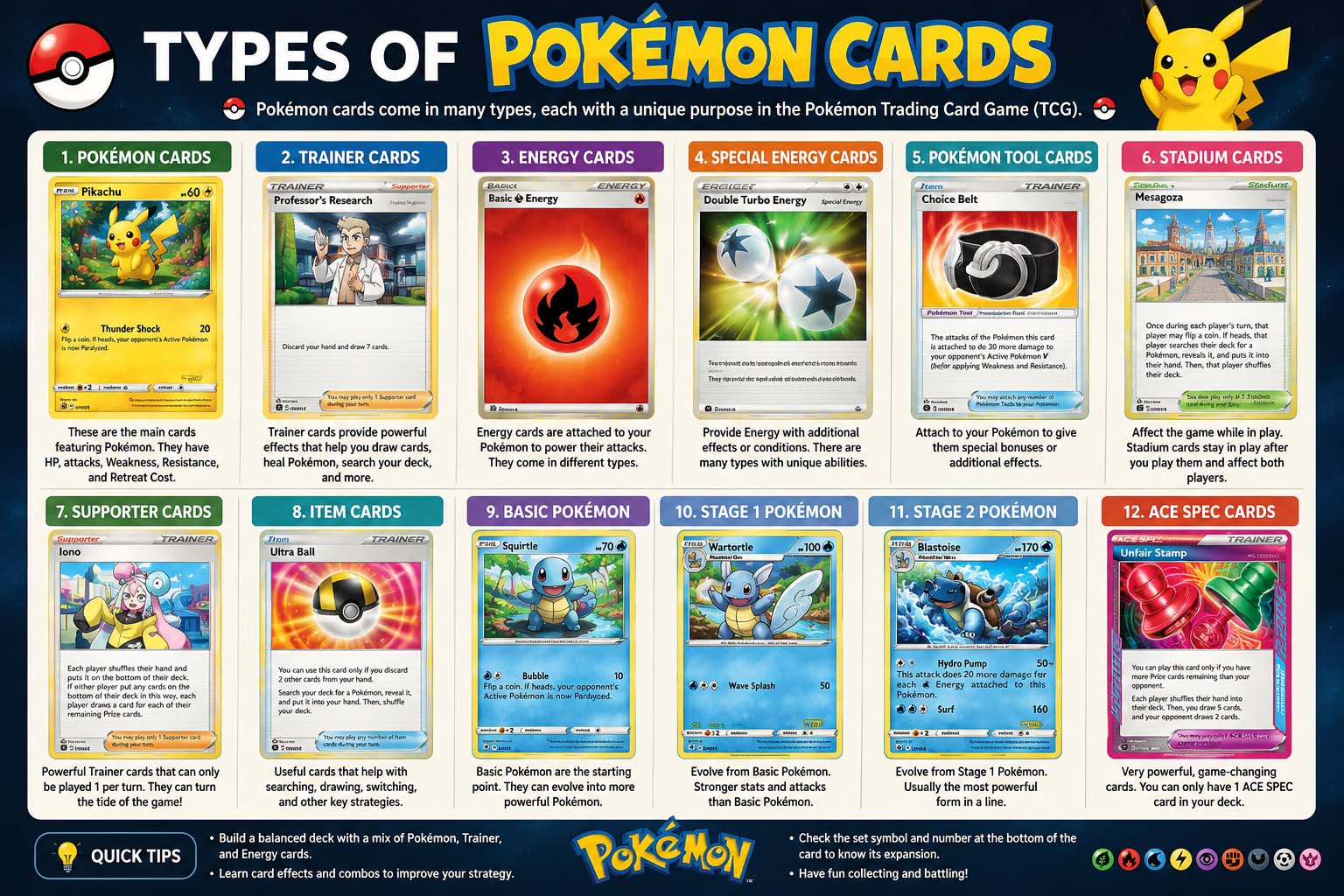
Types of pokemon cards guide, last updated: October 14, 2026
If you just opened your first booster pack, you may wonder why some cards say “Trainer,” others show shiny art and a few carry labels like ex or ACE SPEC. The types of pokemon cards fall into three main groups, and each group does a different job in a match or in a collection. In addition, newer sets add special rarities that change how a card looks and how hard it is to pull. This guide explains every card type, the rarity levels and what is legal in the Standard format today.
Types of Pokemon Cards: The Three Main Categories
According to this 2026 rules guide from Mythras, the Pokémon Trading Card Game has three card categories. Therefore, every legal deck uses a mix of these groups.
| Card Type | What It Does | Needed in a Deck |
|---|---|---|
| Pokémon | The only cards that attack | Yes, at least one Basic Pokémon |
| Trainer | Support your plan (Items, Supporters, Stadiums and Pokémon Tools) | Yes, in most decks |
| Energy | Pay the cost of attacks | Yes, in most decks |
A deck has 60 cards, and you can run up to four copies of any card with the same name. However, Basic Energy is the exception, so you can add as many as you need.
Pokémon Cards
Pokémon cards are the stars of every deck. In addition, each one shows HP, a Pokémon type, attacks, a weakness, a retreat cost and an evolution stage. For example, you can read about grass type weakness to see how weaknesses change a match.
Basic Pokémon
Basic Pokémon can be played straight from your hand. For example, Pikachu, Charmander and Eevee are Basic Pokémon. Because of this, every deck needs at least one Basic Pokémon, or you cannot start the game.
Stage 1 and Stage 2 Pokémon
Stage 1 and Stage 2 Pokémon must be placed on the matching earlier stage that is already in play. For instance, Charmander becomes Charmeleon, and then Charizard. Also, you cannot evolve a Pokémon on the turn it entered play or on your first turn of the game.
Pokémon ex and Mega Evolution ex
Pokémon ex are stronger cards with more HP. However, there is a price. When a Pokémon ex is Knocked Out, your opponent takes two Prize cards instead of one. In addition, the Mega Evolution series brought back Mega Evolution Pokémon ex, and the rule box on a card such as Mega Absol ex says your opponent takes three Prize cards when it is Knocked Out. As a result, these cards are powerful but risky.
Types of Pokemon Cards: Trainer Cards
Trainer cards do not battle. Instead, they search your deck, draw cards, heal damage and set up the field. In fact, the Bulbapedia Trainer card page lists several subtypes with different rules.
Item and Supporter Cards
First, you can play as many Item cards as you like each turn. Supporters are usually stronger, but you may play only one per turn. Moreover, the player who goes first cannot play a Supporter on the first turn. Therefore, choosing the right Supporter each turn is a key skill for new players.
Stadium and Pokémon Tool Cards
Meanwhile, a Stadium stays in play and affects both players, and it leaves when a different Stadium is played. Also, only one Stadium can be in play at a time. A Pokémon Tool, on the other hand, attaches to one Pokémon and gives it a bonus, and each Pokémon can hold only one Tool.
ACE SPEC Cards
ACE SPEC is a label, not a separate card category. According to Bulbapedia, an ACE SPEC card can be an Item, a Pokémon Tool, a Stadium or a Special Energy. However, a deck may contain only one ACE SPEC card of any kind, so you must choose carefully.
Types of Pokemon Cards: Energy Cards
Energy cards let your Pokémon attack because most attacks cannot be used without them. Also, you can attach one Energy card from your hand to one of your Pokémon each turn. Next, Basic Energy comes in eight kinds: Grass, Fire, Water, Lightning, Psychic, Fighting, Darkness and Metal. Meanwhile, Special Energy gives extra effects, such as counting as more than one type. Please note that older Fairy Energy cards exist, but they are the one kind of Basic Energy that is not allowed in tournaments.
Types of Pokemon Cards by Rarity
Rarity tells you how a card was distributed. However, it does not tell you how much the card is worth. According to Misprint’s 2026 rarity guide, the main ladder looks like this:
| Rarity | Symbol and Meaning |
|---|---|
| Common | Black circle, so these are most cards in a set |
| Uncommon | Black diamond, but still easy to pull |
| Rare | Black star, the first premium level |
| Double Rare | Two black stars, usually Pokémon ex in standard art |
| Ultra Rare | Two silver stars, for full-art Trainers and similar cards |
| Illustration Rare | One gold star, for alternate full-art cards |
| Special Illustration Rare | Two gold stars, for alternate full-art ex and Supporters |
| Hyper Rare | Three gold stars, for gold full-art secret rares |
| Mega Attack Rare | Full-art Mega ex, found in about 1 in 29 packs where they appear |
| Mega Hyper Rare | Gold Mega ex, found in about 1 in 540 to 1 in 1,800 packs |
Pull rates differ by set, so treat these odds as a guide. Still, Mega Hyper Rare cards are described as the rarest regular pulls in the modern game.
Types of Holo Pokemon Cards
Holographic finishes are some of the most popular pulls. First, a regular holo has shiny artwork on a standard card. Second, a reverse holo puts the foil on the card body instead, and it uses the same symbol as the non-foil version. Finally, Illustration Rare and Special Illustration Rare cards use full artwork that tells a small story, and collectors often chase them in every new set.
Players who enjoy other card games can try the hand and foot card game.
Which Types of Pokemon Cards Are Legal in Standard?
Legality, however, depends on the regulation mark at the bottom of the card, not on the set. Per PokeGuardian, cards with H, I and J marks, and any later marks, are legal, while G-mark cards have rotated out. The new format started in Pokémon TCG Live on March 26, 2026, and in official events on April 10, 2026.
The Bulbapedia 2026-27 Standard page lists the legal sets. They include Scarlet & Violet sets from Temporal Forces to White Flare (H mark or later) and the Mega Evolution series, from Mega Evolution to Pitch Black. Therefore, always check the mark before you build a deck. New cards usually become tournament legal about two weeks after release.
How Types of Pokemon Cards Affect Deck Building
In short, a balanced deck uses all three groups. Specifically, most players run a smaller group of Pokémon, a large group of Trainers for drawing and searching, and enough Energy to attack. The exact numbers vary by strategy. However, new players often add too much Energy and too few Trainers, which makes the deck less consistent.
Beginner Tips for Pokémon Cards
- First, learn the rarity symbols so you know what you pulled.
- Next, read every attack and rule box before you play a card.
- Also, remember that rarity does not equal strength in a match.
- Then, put valuable cards in sleeves right away.
- Finally, check the regulation mark before a tournament.
For another beginner topic, see how to evolve eevee into umbreon.
Pokemon Cards FAQ
How many types of pokemon cards are there?
There are three main categories: Pokémon, Trainer and Energy. However, each category has subtypes, and the cards also come in many rarities and finishes.
What is the rarest Pokémon card type?
In the Mega Evolution era, Mega Hyper Rare cards are described as the rarest regular pulls, at roughly 1 in 540 to 1 in 1,800 packs depending on the set.
Are holo cards always valuable?
No. A symbol shows how a card was distributed, while demand, the Pokémon, the set and condition drive the price.
What is the difference between holo and reverse holo?
A regular holo has shiny artwork. In contrast, a reverse holo has foil on the card body.
Can I use ACE SPEC cards in a deck?
Yes, but only one ACE SPEC card is allowed per deck, and the card must be legal in your format.
Conclusion
The types of pokemon cards are simple once you know the three groups: Pokémon attack, Trainers support your plan and Energy pays for attacks. Next, learn the rarity ladder and check the regulation mark, and you will build better decks and spot valuable pulls faster.
Sources: Mythras, Bulbapedia (Trainer cards), Bulbapedia (ACE SPEC), Bulbapedia (2026-27 Standard), PokeGuardian, Misprint, Pocketmonsters.net.