
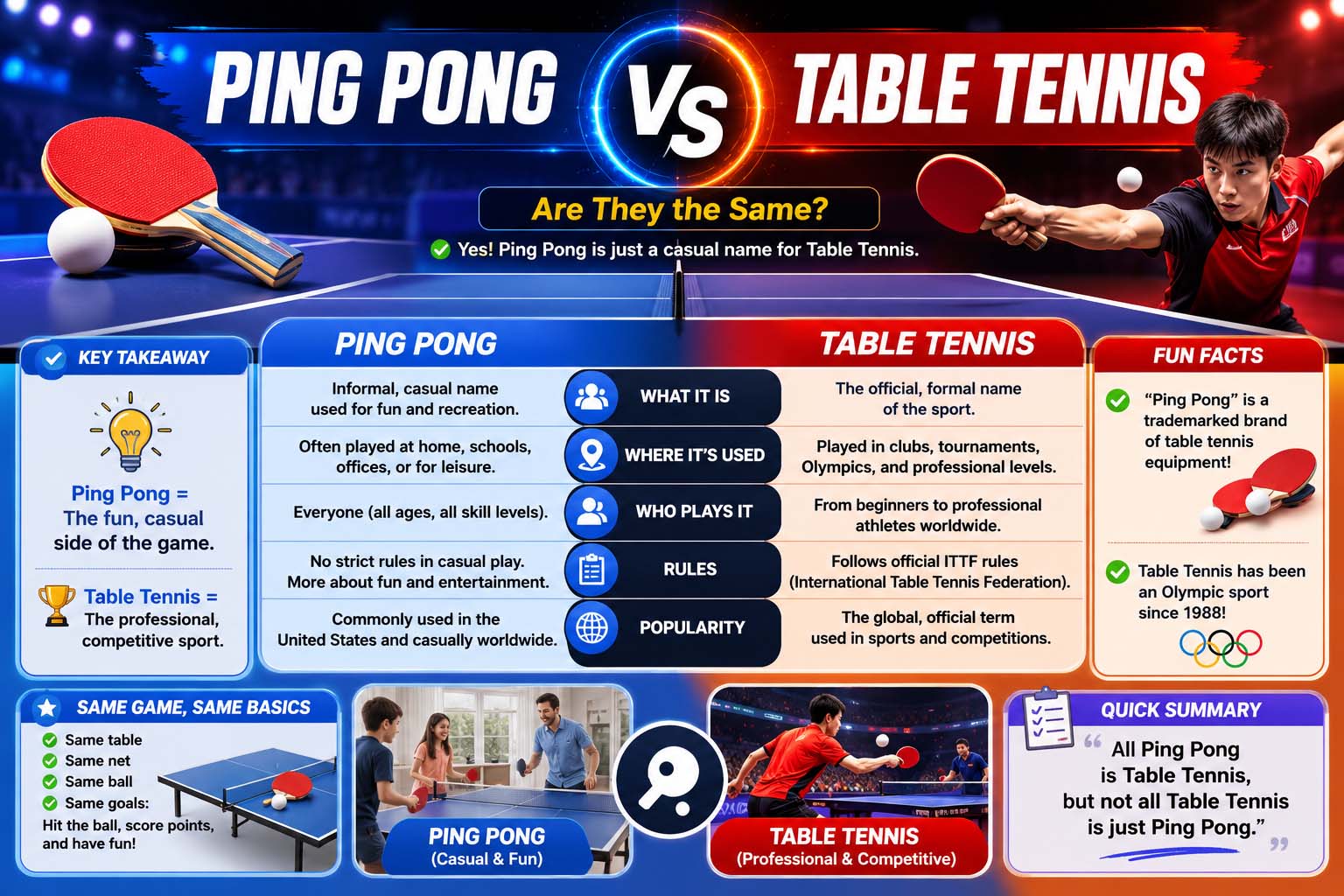
Many people use the terms interchangeably, but is there really a difference between ping pong and table tennis? The short answer is yes—and no. Both names describe the same basic racket sport, yet they often represent different styles of play, levels of competition, and player expectations.
If you’re new to the sport, understanding the terminology can help you choose the right equipment, learn the official rules, and decide whether you’re interested in casual games with friends or competitive tournaments.
This guide explains where the names came from, how the sport evolved, and whether there are any practical differences between ping pong and table tennis today.
What Is the Difference Between Ping Pong and Table Tennis?
The most common answer to what is the difference between ping pong and table tennis depends on the context.
In casual conversation, the two terms usually mean exactly the same sport. Both involve two or four players hitting a lightweight ball back and forth across a table divided by a net.
In competitive sports, however, “table tennis” is the official name recognized by international organizations. “Ping pong” is more often used to describe recreational play at home, schools, offices, or community centers.
Because of this distinction, players involved in organized competitions almost always refer to the sport as table tennis.
A Quick Comparison
Here’s a simple overview of the most common differences.
| Feature | Ping Pong | Table Tennis |
|---|---|---|
| Typical setting | Casual play | Organized competition |
| Official sport name | Usually no | Yes |
| Rules | Often flexible | Standardized |
| Equipment | Recreational | Competition-approved |
| Skill level | Beginner to casual | Beginner to professional |
| Governing body | None | International Table Tennis Federation (ITTF) |
Although these differences are common, the game itself remains fundamentally the same.
Where Did the Two Names Come From?
The sport began in England during the late nineteenth century as an indoor version of lawn tennis.
Early players experimented with different names, including:
- Indoor tennis
- Gossima
- Whiff-whaff
- Ping pong
The name “ping pong” became especially popular because it imitated the sound made when the ball struck the paddle and table.
Later, the term became associated with a registered trademark in some countries. As organized competition grew, governing bodies adopted “table tennis” as the official name of the sport.
Today, international tournaments, Olympic competitions, and professional organizations all use “table tennis.”
Equipment Differences
The equipment used for casual games and professional matches can vary significantly.
Paddles
Recreational paddles are generally designed for durability and affordability.
Professional table tennis rackets use specialized rubber surfaces that create much more spin and control.
Advanced players often customize their rackets by selecting different blade materials and rubber combinations.
Balls
Modern competition uses lightweight plastic balls that meet official size and weight standards.
Casual players often use inexpensive training balls that are perfectly suitable for recreational games but may not perform as consistently.
Tables
Recreational tables are available in many sizes and materials.
Tournament tables must meet strict specifications for:
- Height
- Surface finish
- Bounce consistency
- Dimensions
- Net placement
These standards ensure fair competition at every level.
Playing Style
One reason people notice a difference between table tennis and ping pong is the style of play.
Casual Ping Pong
Friendly games often focus on enjoyment rather than strict technique.
Players usually:
- Rally for fun
- Experiment with trick shots
- Modify rules
- Use slower swings
- Play without formal scoring
The goal is entertainment rather than competition.
Competitive Table Tennis
Tournament players train extensively to improve:
- Footwork
- Spin generation
- Ball placement
- Serve technique
- Reaction speed
- Tactical decision-making
Professional rallies can reach remarkable speeds while still maintaining incredible precision.
If you enjoy comparing cue sports and racket sports, learning about snooker vs pool provides another interesting example of how two similar-looking games differ in equipment, rules, and competitive strategy.
Rules: Mostly the Same
Whether you call it ping pong or table tennis, the core rules remain very similar.
Players must:
- Serve behind the end line.
- Allow the ball to bounce once on each side.
- Hit the ball over the net.
- Avoid double bounces.
- Win points when the opponent fails to return the ball legally.
Official tournaments follow the rules established by the International Table Tennis Federation.
Casual games often introduce house rules, such as playing to different point totals or allowing relaxed serving techniques.
Scoring System
Modern competitive table tennis uses games played to 11 points.
A player must win by at least two points.
Matches are usually played as the best of five or best of seven games.
Many recreational players still prefer older scoring systems, including games to 21 points or informal scoring methods that suit their group.
Why Professional Players Prefer the Term “Table Tennis”
Competitive athletes almost always use the term “table tennis.”
There are several reasons for this.
First, it is the official name recognized worldwide.
Second, it distinguishes organized competition from casual recreation.
Finally, the name reflects the sport’s structured rules, coaching systems, rankings, and international tournaments.
Professional players often spend years refining techniques such as topspin loops, defensive chops, serve variation, and footwork drills that go far beyond the casual games many people call ping pong.
Does the Name Change the Sport?
Not really.
Whether someone says “ping pong” or “table tennis,” both terms describe the same basic activity of hitting a lightweight ball across a table using small paddles.
The biggest difference usually comes from the environment.
A family playing after dinner may naturally call it ping pong.
An athlete preparing for a regional championship will almost certainly call it table tennis.
Understanding this distinction helps explain why both names continue to exist today without causing confusion among most players.
Difference Between Ping Pong and Table Tennis in Competitive Play
If you’re wondering what is the difference between table tennis and ping pong, organized competition provides the clearest answer.
Professional table tennis follows standardized rules established by the International Table Tennis Federation (ITTF). These rules cover everything from table dimensions and ball specifications to paddle construction and serving techniques.
- Heavy topspin and backspin
- Fast attacking loops
- Precise ball placement
- Quick footwork
- Tactical shot selection
- Consistent serving techniques
By comparison, recreational ping pong is much more flexible. Friends and family often modify rules, play with basic equipment, and focus on having fun rather than tournament-level performance.
Which One Should Beginners Choose?
For someone just starting, the name isn’t nearly as important as learning the fundamentals.
Whether you call it ping pong or table tennis, beginners should focus on:
- Holding the paddle correctly
- Learning a balanced stance
- Keeping rallies under control
- Practicing consistent serves
- Developing basic footwork
Once these skills become comfortable, players can gradually introduce spin, faster rallies, and more advanced strategies.
Many local clubs welcome beginners, making organized table tennis an excellent way to improve while meeting other players.
Tips to Improve Your Game
Improvement comes from practicing the right habits rather than simply playing more matches.
Here are a few tips that benefit both casual and competitive players.
Master the Ready Position
Stay on the balls of your feet with your knees slightly bent.
This athletic stance helps you react quickly to shots in any direction.
Focus on Footwork
Many beginners reach for the ball instead of moving toward it.
Good footwork creates better balance, stronger shots, and more consistent rallies.
Learn Spin Gradually
Spin is one of the biggest differences between beginner and advanced players.
Start by understanding simple topspin and backspin before experimenting with more complex serves and returns.
Practice Consistent Serves
A reliable serve gives you an advantage from the very first shot.
Instead of trying difficult trick serves immediately, aim for accuracy, placement, and consistency.
Play Against Different Opponents
Facing players with different styles helps you adapt to varying speeds, spins, and strategies.
The wider your experience, the more complete your game becomes.
Common Misconceptions
People often misunderstand the relationship between ping pong and table tennis.
Myth: They’re Completely Different Sports
False.
The basic game is the same. The biggest difference is usually whether you’re talking about casual recreation or organized competition.
Myth: Professional Players Never Say “Ping Pong”
Not always.
Many players use both terms in everyday conversation, although “table tennis” is preferred in official settings.
Myth: Expensive Equipment Makes You Better
Quality equipment can help, but technique matters much more.
Good footwork, timing, and practice have a far greater impact than buying the most expensive racket.
Myth: The Rules Are Completely Different
Most recreational games follow the same core principles as official table tennis, even if players simplify certain rules for fun.
How to Transition from Casual to Competitive Play
If you’ve only played with friends but want to compete, the transition is easier than many people expect.
Start by:
- Learning the official serving rules.
- Playing games to 11 points.
- Using a competition-quality paddle.
- Practicing basic spin techniques.
- Joining a local table tennis club.
- Participating in beginner tournaments.
Playing with experienced opponents helps you improve much faster than practicing alone.
Frequently Asked Questions
What’s the difference between ping pong and table tennis?
The main difference is how the terms are commonly used. “Table tennis” is the official name of the sport in organized competition, while “ping pong” often refers to casual recreational play.
Is the equipment different?
The equipment can be. Competitive table tennis uses ITTF-approved tables, balls, and rackets, while casual players often use recreational equipment.
Can I play professionally if I learned through ping pong?
Yes. Many competitive players first learned the game casually before moving into organized table tennis.
Which name is more common?
It depends on the audience. Casual players frequently say “ping pong,” while clubs, coaches, and tournaments generally use “table tennis.”
Is table tennis harder than ping pong?
The game itself is the same, but competitive table tennis requires much greater skill, physical fitness, strategy, and consistency.
The Role of Practice and Reaction Time
Regardless of which name you use, success depends on practice and quick reactions.
Fast reflexes, accurate timing, and smooth movement all improve with regular training. If you also enjoy competitive online gaming, you’ll know that responsiveness matters there too. Understanding how to lower ping in games highlights a similar idea—reducing delays leads to faster reactions, whether you’re playing online or returning a fast table tennis shot.
Key Takeaways
Understanding the difference between ping pong and table tennis helps clear up one of the most common questions about the sport. While both names describe the same basic game, “table tennis” is the official term used in leagues and international tournaments, whereas “ping pong” is more closely associated with casual play among friends and family.
For beginners, the terminology matters far less than learning solid fundamentals. Focus on developing consistent strokes, good footwork, and proper serving technique. As your skills improve, you can decide whether you simply enjoy recreational matches or want to explore the faster, more technical world of competitive table tennis.