Types of word puzzles guide, last updated: October 15, 2026
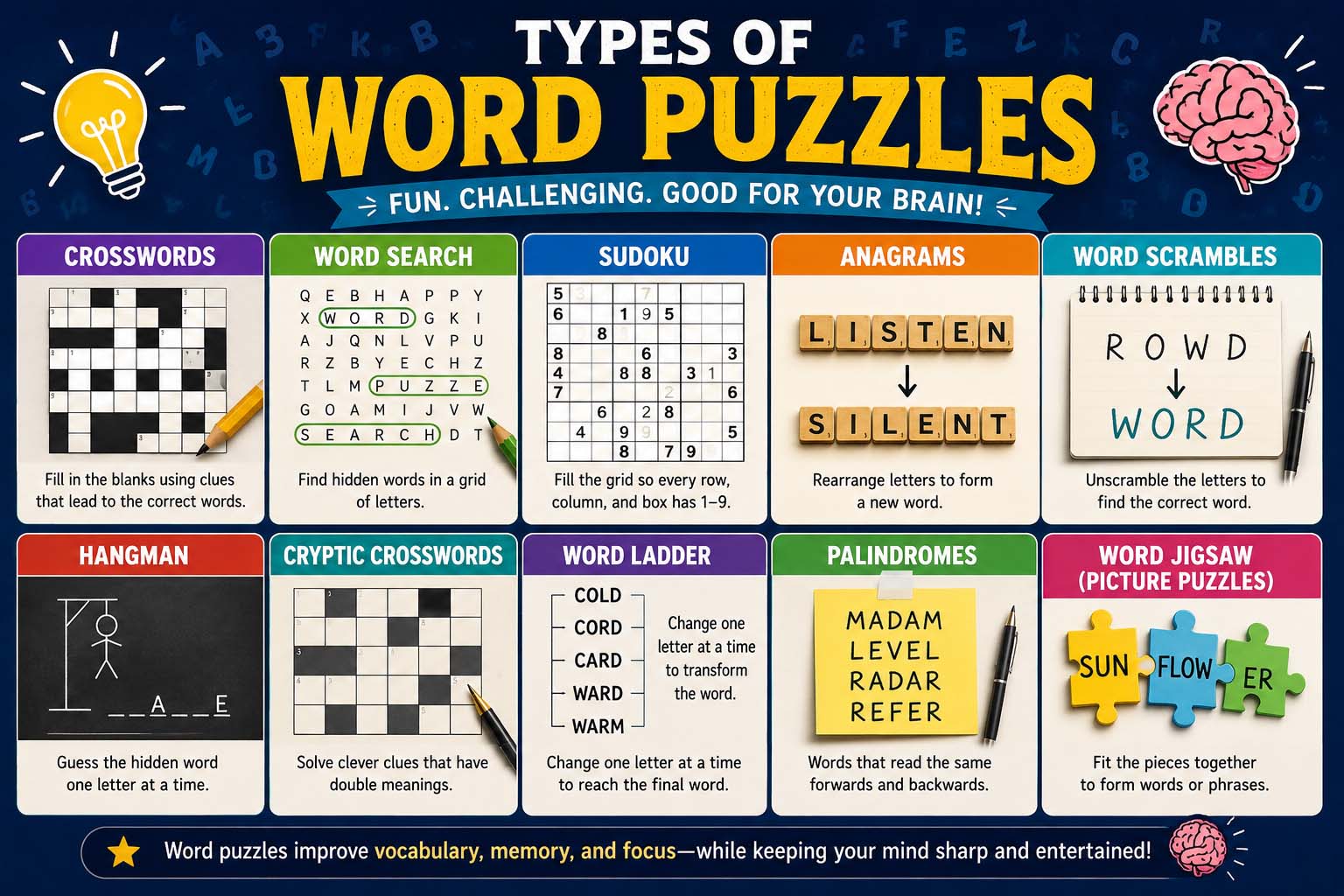
The main types of word puzzles are crosswords, cryptic crosswords, word searches, anagrams, word scrambles, word ladders and daily guessing games such as Wordle. However, each type tests a different skill. Some need a big vocabulary, while others need logic or patience. Therefore, this guide explains how every type works, which ones suit beginners and where each one came from.
Types of Word Puzzles at a Glance
First, the table below compares the most popular types of word puzzles. Then, use it to pick a style that matches your skill level. For other styles of brain games, see our guide to the types of puzzles.
| Puzzle | Difficulty | Main Skill |
|---|---|---|
| Word search | Easy | Pattern spotting |
| Word scramble | Easy | Spelling |
| Fill-in puzzle | Easy to medium | Logic |
| Crossword | Medium | Vocabulary and trivia |
| Anagram | Medium | Quick thinking |
| Word ladder | Medium | Vocabulary and logic |
| Daily guess game | Easy to medium | Deduction |
| Cryptic crossword | Hard | Wordplay |
Classic Types of Word Puzzles
Crossword Puzzles
A crossword asks you to fill a grid using clues. Answers cross each other, so every letter you solve helps with another clue. According to Guinness World Records, Arthur Wynne made the first crossword, and it ran in the New York World on December 21, 1913. Today, crosswords still use definitions, synonyms and trivia clues.
Cryptic Crosswords
Cryptic crosswords hide wordplay inside each clue. For example, a clue can contain a definition plus an anagram, a hidden word or a double meaning. As a result, they are the hardest of the classic types of word puzzles. Even so, they become rewarding with practice.
Word Search Puzzles
A word search hides words inside a grid of letters. According to Wikipedia, Norman E. Gibat is credited with it, and he published the first one on March 1, 1968, in Oklahoma. Also, words run horizontally, vertically or diagonally, and sometimes backward. Therefore, it is a good first puzzle for beginners.
Word Ladders
In a word ladder, you simply change one letter at a time to turn one word into another. For example, COLD becomes CORD, then CORM, then WORM and finally WARM. According to Wikipedia, Lewis Carroll invented it. Then, he published it as “Doublets” in Vanity Fair, starting on March 29, 1879.
Anagram and Scramble Types of Word Puzzles
Anagrams
First, an anagram rearranges the letters of a word to make a new one. For example, LISTEN becomes SILENT. Moreover, many mobile games use anagrams as their main mechanic.
Word Scrambles
Next, a word scramble mixes the letters of one word, and you put them back in order. Because the answer is a single word, it is easier than an anagram. Also, it suits families and kids.
Fill-In Puzzles
Finally, a fill-in puzzle gives you a list of words and an empty grid. Your job is to fit every word into the right place. Therefore, it relies on logic more than vocabulary.
Modern Types of Word Puzzles and Word Games
Newer word games work well on phones. The best known is Wordle. According to Breaking News English, Josh Wardle made it for his partner. Also, players get six tries to guess a five-letter word. Soon after its launch, millions played it daily, and The New York Times bought it in 2022.
- Daily guess games: First, you get one puzzle per day and share your score.
- Multiplayer word games: You race friends, so speed and vocabulary both matter.
- Tile-based word games: Also, you build words from letter tiles on a board.
- Story word games: Finally, solving puzzles unlocks new levels and chapters.
Meanwhile, if you want more quick games, try these games to play when bored.
Which Types of Word Puzzles Are Best for You?
Your choice depends on your goal. Use this simple guide.
- First, pick word searches or scrambles if you want a relaxing start.
- Next, choose crosswords or word ladders if you like to think.
- Also, try daily guess games if you want a quick habit.
- Finally, take on cryptic crosswords when you want a real challenge.
To improve faster, start with the easy clues. In addition, look for common endings such as -ING and -TION. Finally, do not rush, because a wrong answer makes the neighbouring clues harder.
Types of Word Puzzles FAQ
What are the most popular types of word puzzles?
Overall, crosswords, word searches, anagrams, word scrambles, word ladders and daily guess games are the most popular.
Which word puzzle is best for beginners?
Word searches and word scrambles are best, because the rules are simple and you need no special vocabulary.
What is the hardest type of word puzzle?
Cryptic crosswords are usually the hardest, since each clue has layers of wordplay.
Who invented the crossword?
Arthur Wynne published the first one in the New York World on December 21, 1913, according to Guinness World Records.
Do word puzzles help your vocabulary?
Yes, they can. In fact, regular practice shows you new words and spelling patterns.
Conclusion
Overall, there are many types of word puzzles, and each one trains a different skill. In short, start with an easy style, move up to crosswords and word ladders, and save cryptic crosswords for later. Finally, try one daily puzzle, because steady practice builds vocabulary and confidence.
Sources: Guinness World Records, Wikipedia: Word search, Wikipedia: Word ladder, Breaking News English.