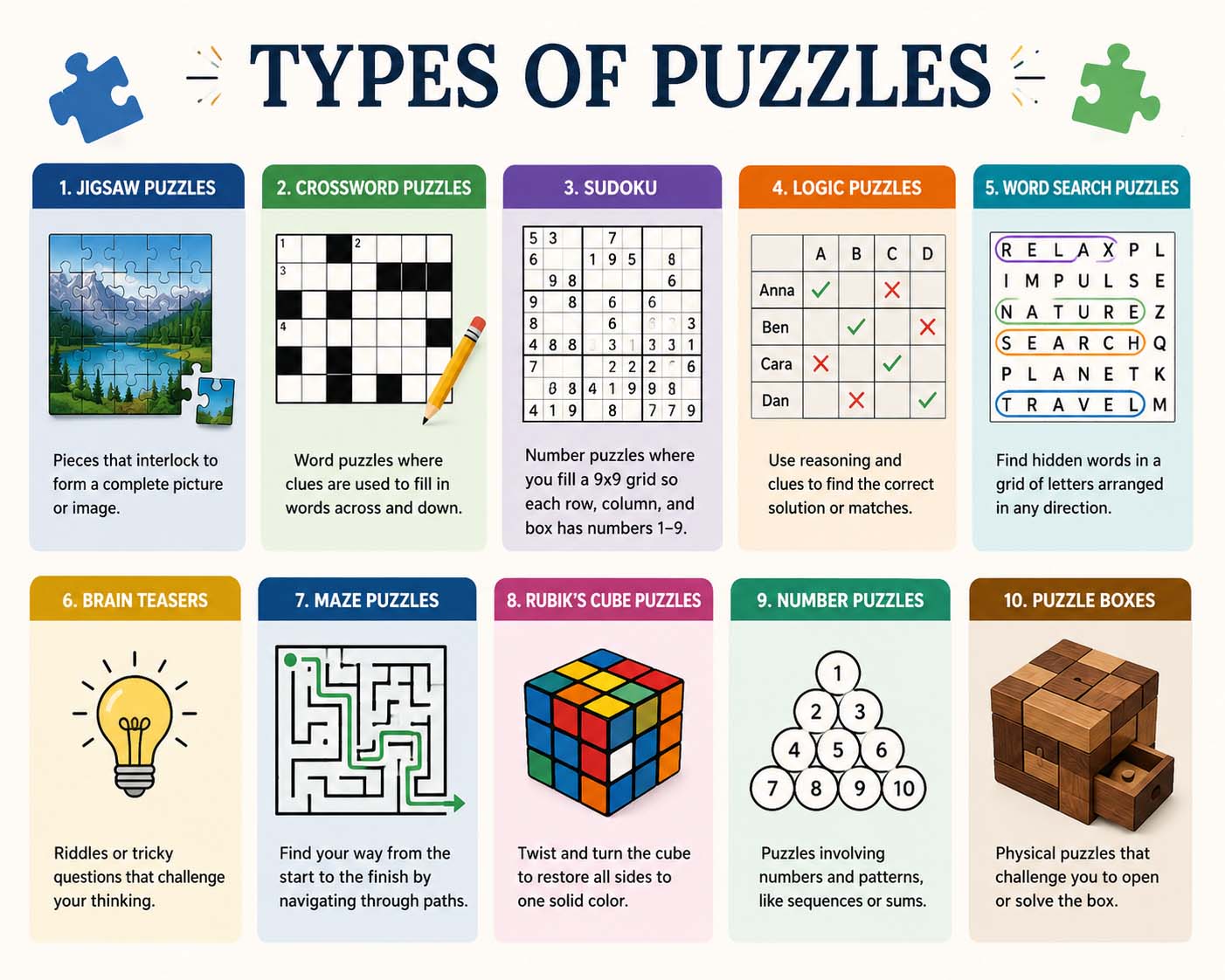
Whether you’re solving a tricky dungeon puzzle in a video game, completing a 1,000-piece jigsaw, or trying to beat your best Rubik’s Cube time, puzzles come in many different forms. In fact, each type challenges your brain in a unique way, making puzzle games one of the most popular gaming genres across PC, console, mobile, and tabletop gaming. If you’ve ever wondered about the different types of puzzles, this guide explains the most common categories, how they work, who they’re best for, and why they continue to attract millions of players around the world.
Why Puzzle Games Remain So Popular
Puzzle games have been around for decades, yet they continue to thrive alongside action, RPG, and strategy games.
Players enjoy puzzles because they:
- Improve logical thinking
- Reward creativity
- Offer relaxing gameplay
- Challenge memory and observation
- Provide satisfying problem-solving moments
- Appeal to players of every age
Additionally, many modern games mix puzzles with adventure, platforming, survival, or exploration to create memorable gameplay.
Quick Comparison of Popular Puzzle Types
| Puzzle Type | Difficulty | Best For | Solo or Multiplayer |
|---|---|---|---|
| Jigsaw | Easy–Hard | Relaxing gameplay | Solo |
| Crossword | Medium | Vocabulary | Solo |
| Sudoku | Medium | Logic lovers | Solo |
| Logic Puzzle | Medium–Hard | Critical thinking | Solo |
| Sliding Puzzle | Easy–Hard | Spatial reasoning | Solo |
| Escape Room Puzzle | Hard | Teamwork | Both |
| Rubik’s Cube | Hard | Speed solving | Solo |
| Match-3 Puzzle | Easy | Casual gaming | Solo |
| Physics Puzzle | Medium | Creative solutions | Mostly Solo |
| Puzzle Platformer | Medium | Adventure gamers | Solo |
Jigsaw Puzzles
Jigsaw puzzles remain one of the world’s most recognizable puzzle types.
Specifically, players connect individual pieces to recreate a complete picture.
Common sizes include:
- 100 pieces
- 300 pieces
- 500 pieces
- 1,000 pieces
- 2,000+ pieces
Moreover, modern digital versions are also available on PC, mobile devices, and gaming consoles.
Beginner Tip
First, start by sorting edge pieces before filling the center.
Logic Puzzles
Logic puzzles challenge reasoning instead of memorization.
In particular, players solve problems using clues rather than guessing.
Popular examples include:
- Einstein’s Riddle
- Grid logic puzzles
- Deduction games
- Detective puzzles
Therefore, these puzzles reward patience and careful thinking.
Crossword Puzzles and Other Word Games
Crossword puzzles combine language skills with problem-solving.
Benefits include:
- Better vocabulary
- Improved memory
- Pattern recognition
- General knowledge practice
Additionally, players interested in language challenges can explore other types of word puzzles.
Overall, digital crossword apps have made this classic puzzle even more accessible.
Sudoku Puzzles
Sudoku focuses entirely on numbers and logic.
Specifically, each row, column, and box must contain every number exactly once.
Unlike math problems, Sudoku requires logical deduction rather than calculations.
Sliding Puzzles
Sliding puzzles involve moving pieces around a confined space until the correct arrangement appears.
Popular examples include:
- 15 Puzzle
- Number Slider
- Image Slider
As a result, these puzzles improve spatial awareness and planning.
Match-3 Puzzle Games
Match-3 games remain one of the biggest casual gaming genres.
In these games, players match identical objects to clear the board.
Examples include:
- Candy matching
- Gem matching
- Jewel puzzles
- Bubble matching
Although easy to learn, higher levels often require careful planning.
Physics-Based Puzzles
Physics puzzles use realistic movement and object interaction.
Players may need to:
- Cut ropes
- Balance objects
- Build bridges
- Redirect water
- Move platforms
Overall, games in this category reward experimentation.
Puzzle Platformers
Puzzle platformers combine exploration with environmental challenges.
Instead of relying only on jumping, players must solve puzzles to continue.
Common mechanics include:
- Switches
- Doors
- Mirrors
- Lasers
- Gravity
- Time manipulation
Moreover, these games often feature strong storytelling alongside puzzle solving.
Escape Room Puzzles
Escape room games have become increasingly popular because they combine teamwork, problem-solving, and immersive storytelling into a single interactive experience.
Specifically, players solve interconnected puzzles to unlock doors and escape before time runs out.
Challenges may involve:
- Hidden objects
- Codes
- Locks
- Symbols
- Pattern recognition
- Team communication
Overall, both digital and real-life escape rooms use similar puzzle concepts.
Types of Puzzles Similar to the Rubik’s Cube
Many players search for types of puzzles similar to the Rubik’s Cube after mastering the classic 3×3 cube because these challenges offer new levels of difficulty and variation.
Popular alternatives include:
Pyraminx
A pyramid-shaped twisty puzzle that focuses on corner rotations.
Megaminx
A twelve-sided puzzle offering a much greater challenge.
Mirror Cube
Instead of colors, players solve based on different block sizes.
Skewb
A fast-turning cube with unique movement mechanics.
Square-1
This puzzle changes shape while solving, creating a completely different experience.
Ghost Cube
This is one of the most difficult twisty puzzles due to its unusual shape and alignment.
Overall, these puzzles appeal to speedcubers looking for new challenges.
Puzzle Types Found in Video Games
Many modern games combine several puzzle styles.
Examples include:
Environmental Puzzles
In these puzzles, players interact with the game world.
Examples:
- Rotating statues
- Moving blocks
- Activating switches
For example, the sahasra slope tower presents an environmental challenge within its game world.
Inventory Puzzles
In these puzzles, players combine collected items to unlock progress.
In fact, adventure games frequently use this system.
Similarly, searches for bargainer statue locations involve exploration and discovery.
Symbol Puzzles
In these puzzles, players identify matching symbols or hidden clues.
These types of puzzles are often found in horror and mystery games
For instance, the shuro chi wish wall uses a symbol-based system.
Timing Puzzles
In these challenges, success depends on performing actions at the right moment.
Therefore, these puzzles combine reflexes with planning.
Sequence Puzzles
In these puzzles, players activate switches or objects in the correct order.
As a result, pattern recognition is the key skill.
Types of Puzzles for Children
Parents often search for types of puzzles for children that encourage learning while remaining entertaining.
Popular choices include:
- Large-piece jigsaw puzzles
- Shape matching puzzles
- Alphabet puzzles
- Number puzzles
- Animal puzzles
- Color matching games
These puzzles help develop:
- Hand-eye coordination
- Memory
- Fine motor skills
- Problem-solving
- Concentration
Types of Puzzles for Kids
Older children usually enjoy slightly more challenging activities.
Some excellent types of puzzles for kids include:
- Sudoku for beginners
- Maze puzzles
- Logic grids
- Treasure hunts
- Block puzzles
- Tangrams
- Word searches
Overall, these games encourage independent thinking while remaining fun.
Types of Puzzles for Toddlers
Very young children benefit from simple, colorful puzzles.
Recommended types of puzzles for toddlers include:
- Wooden peg puzzles
- Shape sorters
- Chunky animal puzzles
- Matching cards
- Large-piece floor puzzles
Above all, parents should choose puzzles with large, easy-to-hold pieces and age-appropriate designs.
Which Puzzle Type Is Best?
Your ideal puzzle depends on what you enjoy most.
| Goal | Recommended Puzzle |
|---|---|
| Relaxing gameplay | Jigsaw |
| Improve logic | Sudoku |
| Vocabulary practice | Crossword |
| Fast thinking | Match-3 |
| Team challenges | Escape Room |
| Spatial reasoning | Sliding Puzzle |
| Speed solving | Rubik’s Cube |
| Adventure gaming | Puzzle Platformer |
Likewise, players looking for relaxing card-based challenges can explore different types of solitaire.
Tips to Become Better at Puzzle Games
Improvement comes primarily with practice rather than luck. In fact, repeated effort helps build understanding, sharpen techniques, and develop confidence over time, leading to steady progress in any skill or activity.
Helpful strategies include:
- Study patterns before acting.
- Break large problems into smaller ones.
- Avoid rushing difficult puzzles.
- Learn from failed attempts.
- Practice regularly.
- Watch experienced players solve similar puzzles.
- Try different puzzle genres.
As a result, many puzzle skills transfer between games, making future challenges easier.
Common Puzzle-Solving Mistakes
Even experienced players develop habits that slow their progress.
Common mistakes include:
- Guessing instead of analyzing
- Ignoring clues
- Overthinking simple solutions
- Skipping tutorials
- Not organizing puzzle pieces
- Giving up too quickly
Therefore, taking short breaks often helps when you’re stuck.
Do Puzzle Games Improve Brain Skills?
Research suggests that regularly solving puzzles may help strengthen several cognitive skills.
Possible benefits include:
- Better memory
- Faster pattern recognition
- Improved concentration
- Stronger logical reasoning
- Better visual processing
Although puzzles are not a substitute for formal learning, they provide enjoyable mental exercise for players of all ages.
Frequently Asked Questions
What Are the Most Common Types of Puzzles?
The most common puzzle types include jigsaw puzzles, Sudoku, crosswords, logic puzzles, sliding puzzles, escape room puzzles, match-3 games, and Rubik’s Cube-style puzzles.
Which Puzzle Is Easiest for Beginners?
Large-piece jigsaw puzzles and basic match-3 games are excellent starting points because they’re simple to learn and rewarding to complete.
What Are Types of Puzzles Similar to Rubik’s Cube?
Popular alternatives include the Pyraminx, Megaminx, Mirror Cube, Skewb, Square-1, and Ghost Cube. Although each has unique mechanics, they build on the same twisty puzzle concept.
What Are Good Types of Puzzles for Children?
Children often enjoy shape sorters, alphabet puzzles, animal jigsaws, matching games, and colorful floor puzzles that combine learning with play.
What Are the Best Types of Puzzles for Kids?
Maze puzzles, beginner Sudoku, Tangrams, logic games, and treasure hunts are great options for school-age children because they encourage critical thinking.
Which Types of Puzzles Are Suitable for Toddlers?
Toddlers benefit from wooden peg puzzles, chunky animal puzzles, simple shape sorters, and large-piece matching puzzles that support motor skill development.
Ready for Your Next Puzzle?
The wide variety of types of puzzles means there’s something for every kind of player. If you enjoy relaxing gameplay, jigsaw puzzles are a great choice. If you prefer logical challenges, Sudoku and logic grids offer endless practice. Meanwhile, adventure fans can explore puzzle platformers and escape room games, while speed enthusiasts can master Rubik’s Cube-style puzzles.
Trying different puzzle genres is one of the best ways to sharpen your problem-solving skills and keep your gaming experience fresh. Whether you’re playing on a console, PC, mobile device, or with a physical puzzle at home, every solved challenge brings the same rewarding feeling—the satisfaction of figuring it out yourself.