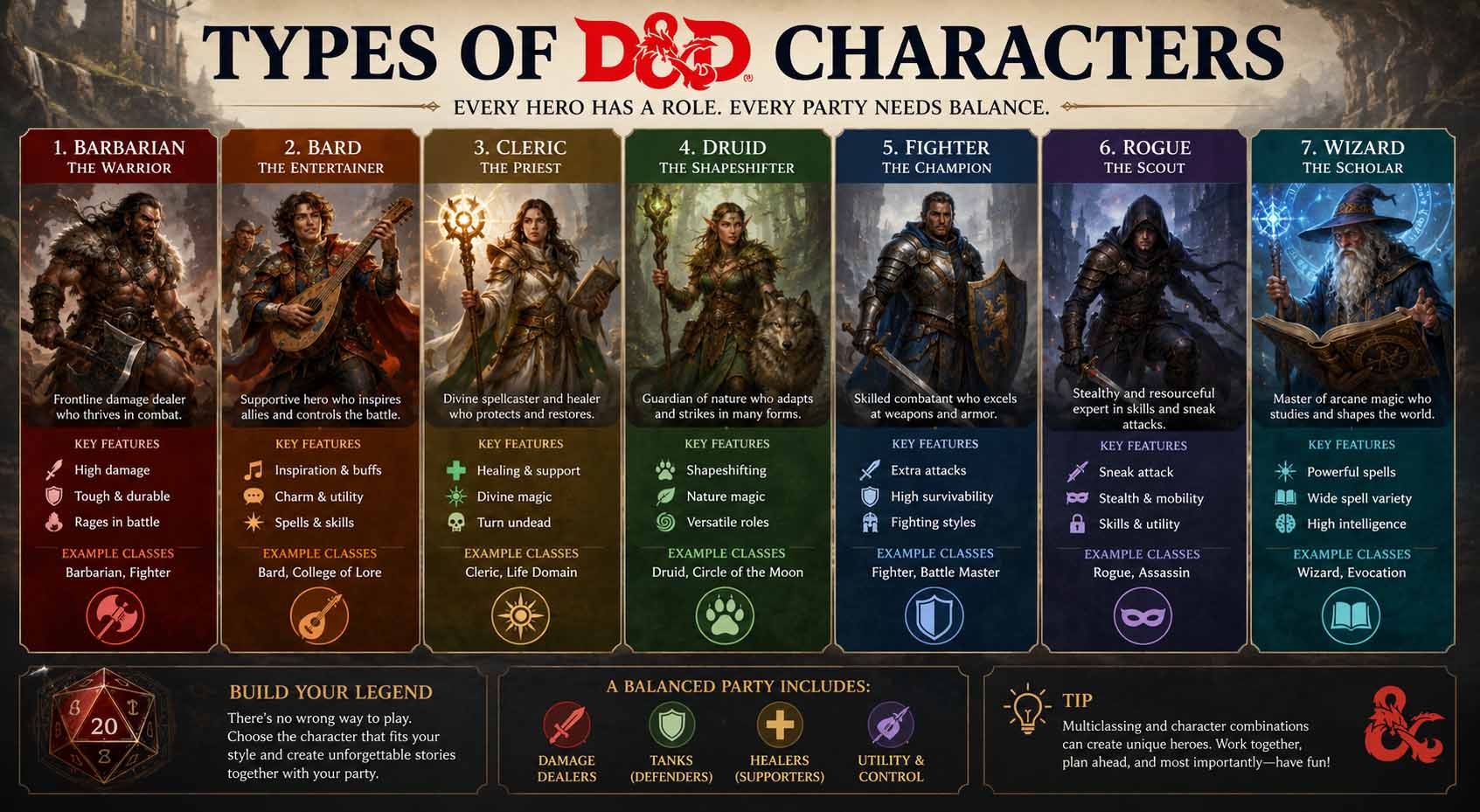
Choosing between the many types of DnD characters can feel like a game of its own, especially when you’re building your first adventurer. Some characters charge into melee combat with heavy armor, while others cast spells, sneak through dangerous areas, heal allies, or talk their way past trouble. The best choice depends less on finding the “strongest” option and more on deciding what you actually want to do during a campaign.
Dungeons & Dragons gives players plenty of freedom because a character isn’t defined by one choice. Your class provides the core gameplay mechanics, while your species, background, ability scores, subclass, equipment, and personality turn those mechanics into a unique adventurer.
So, rather than looking for one perfect character type, it helps to understand how the major options work together.
What Are the Main Types of DnD Characters?
When players talk about character “types,” they usually mean classes. A class determines many of your most significant abilities and shapes what your character does during combat and exploration.
However, two characters from the same class can still play very differently.
For example, one fighter might protect allies with a shield and heavy armor. Meanwhile, another could focus on ranged attacks with a bow. Their class is identical, yet their jobs within the party aren’t.
The main character classes commonly associated with modern D&D include:
- Barbarian
- Bard
- Cleric
- Druid
- Fighter
- Monk
- Paladin
- Ranger
- Rogue
- Sorcerer
- Warlock
- Wizard
Artificer is another familiar option in supported D&D material, although its availability can depend on the rules and campaign your Dungeon Master uses.
This freedom resembles character-building systems across many games. For instance, someone using a wow character lookup may examine a character’s class, equipment, and progression rather than judging the entire build from the class name alone. D&D works differently mechanically, but the same basic idea applies: several character choices combine to create the final playstyle.
Types of DnD Characters for Melee Combat
If you enjoy getting close to enemies and surviving direct fights, martial characters are a natural starting point.
Fighter
Fighters are among the easiest character concepts for new players to understand, yet experienced players can build them in surprisingly complex ways.
They can specialize in swords, shields, bows, heavy weapons, or other combat approaches. Because fighters aren’t locked into one fantasy archetype, they work well for players who already have a specific warrior concept in mind.
A fighter can become a defensive frontline protector, aggressive damage dealer, or mobile combat specialist depending on the build.
Barbarian
Barbarians favor aggressive frontline combat.
Their signature abilities make them effective when fighting directly against dangerous opponents, while their rugged theme fits characters such as tribal warriors, wandering champions, fierce guardians, or battle-hardened adventurers.
Choose a barbarian if you want straightforward physical power without managing a huge spell list.
Monk
Monks approach melee combat differently.
Instead of relying mainly on heavy armor and oversized weapons, they typically emphasize mobility, martial techniques, and precise attacks. As a result, they can feel faster and more tactical than traditional armored warriors.
They’re a good fit for players who enjoy moving around the battlefield rather than simply standing beside one enemy.
Spellcasting Types of Characters in DnD
Magic opens up some of D&D’s broadest gameplay possibilities. However, spellcasters can require more preparation because players need to understand what their spells actually do.
Wizard
Wizards are classic dedicated spellcasters.
Their greatest attraction is versatility. Depending on the spells available to them, they can deal damage, control enemies, solve exploration problems, protect allies, or manipulate the battlefield.
However, that flexibility creates more decisions. Therefore, new players should avoid trying to memorize every possible spell immediately. Instead, learn a small group of frequently used spells first.
Sorcerer
Sorcerers also specialize in arcane magic, but their magical identity differs from a wizard’s scholarly approach.
They work well for players who want their character’s magic to feel innate rather than learned through years of study. Their abilities can also modify how certain spells function, creating interesting tactical choices.
Warlock
Warlocks have one of the most distinctive magical themes.
Their power is commonly connected to a supernatural patron, which can create immediate story hooks for the Dungeon Master. Meanwhile, their mechanics can provide a more focused spellcasting experience than managing a massive collection of spells.
Consequently, warlocks often appeal to players who want both strong role-playing opportunities and recognizable combat options.
Support, Healing, and Utility Characters
Not every useful adventurer needs to produce the biggest damage number.
In fact, support characters can change encounters by keeping teammates alive, improving their chances of success, controlling enemies, or solving problems outside combat.
Cleric
Clerics are often associated with healing, but treating them only as healers undersells the class.
Depending on their choices, clerics can fight, cast offensive magic, strengthen allies, and provide valuable utility. Therefore, you don’t need to spend every turn restoring another player’s hit points.
A well-built cleric can contribute across almost every stage of an adventure.
Bard
Bards combine magic, skills, social abilities, and party support.
They’re especially appealing if you want to participate heavily in conversations and role-playing while still remaining useful during fights. Because they cover several areas rather than one narrow specialty, they can fill gaps in an adventuring group.
Their versatility also rewards creative players who like solving encounters in unexpected ways.
Druid
Druids mix nature-themed magic with flexible abilities.
Depending on the character, they can provide battlefield control, support, exploration tools, and transformation-based gameplay. Consequently, druids are a strong choice for players attracted to nature magic but unwilling to commit to a purely ranged spellcaster.
Stealth, Exploration, and Ranged Character Options
Some players would rather avoid being the adventurer standing directly in front of the dragon.
Fortunately, several different types of DnD characters reward positioning, scouting, exploration, and careful decision-making.
Rogue
Rogues excel at skills, stealth, and opportunistic attacks.
They work particularly well for players who enjoy scouting ahead, finding traps, opening locks, and looking for clever ways to gain an advantage. During combat, positioning often matters more than simply attacking the nearest target.
Outside combat, their broad skill usefulness can make them valuable members of almost any group.
Ranger
Rangers blend martial ability with wilderness-focused skills and magical options.
They’re a natural choice for characters built around hunting, tracking, exploration, archery, or surviving dangerous environments. However, you don’t necessarily have to play a stereotypical forest archer.
Your weapon choice, subclass, background, and personality can push the character in a very different direction.
Hybrid Characters That Mix Combat and Magic
Some players don’t want to choose between swinging a weapon and casting spells.
That’s where hybrid-style classes become appealing.
Paladin
Paladins combine martial combat with magical abilities and strong thematic identity.
They often perform well on the frontline while providing useful benefits to the party. Their beliefs, promises, and personal codes can also create meaningful role-playing opportunities.
For beginners who want armor, weapons, and some magic without becoming a full spellcaster, a paladin can be an appealing middle ground.
Building Around a Theme
You can also create hybrid concepts through subclasses and other character-building choices.
For example, you might design a warrior with magical tricks or a spellcaster capable of surviving closer to the action.
That process can feel similar to learning how to build a commander deck: you usually get better results when individual choices support a clear overall strategy instead of selecting options simply because each one looks powerful by itself.
DnD Character Roles at a Glance
Classes tell you what mechanics you have. Meanwhile, party roles describe how you tend to use those mechanics.
| Character Role | Typical Strength | Good Class Choices |
|---|---|---|
| Frontliner | Fighting enemies up close | Fighter, Barbarian, Paladin |
| Damage Dealer | Producing reliable damage | Fighter, Rogue, Sorcerer, Wizard |
| Support | Helping teammates succeed | Bard, Cleric, Druid |
| Controller | Limiting enemy options | Wizard, Druid, Sorcerer |
| Scout | Stealth and exploration | Rogue, Ranger, Monk |
| Party Face | Social interactions | Bard, Paladin, Warlock |
| Flexible Utility | Handling varied situations | Bard, Wizard, Cleric, Druid |
These roles aren’t strict MMO-style assignments.
A D&D party doesn’t always need one dedicated tank, healer, and damage dealer. Instead, successful groups often rely on overlapping abilities. If one character becomes unavailable, another adventurer can still contribute.
Therefore, think of roles as strengths rather than mandatory jobs.
Species, Backgrounds, and Character Identity
Class isn’t the only way to describe the types of characters in DnD.
Your character’s species helps establish their fantasy identity and traits, while their background describes part of the life they lived before becoming an adventurer. Your campaign’s rules determine the exact options available.
These choices create combinations that feel very different even when two players select the same class.
For instance, two rogues might share similar combat mechanics. However, one could be a former criminal who relies on deception, while another might be an explorer who uses stealth to investigate ancient ruins.
This is where character creation becomes less like choosing a preset hero and more like assembling pieces into something personal. Players who enjoy categorizing collectible game systems, such as learning about types of pokemon cards, may recognize the appeal of understanding each component before deciding how different options work together.
Best DnD Character Types for Beginners
New players don’t need to choose the simplest class, but reducing complexity can make the first few sessions easier.
Fighter is a strong starting point because its basic combat loop is easy to follow. Barbarian can also be approachable for someone who wants a durable melee character.
Meanwhile, rogue suits players who want straightforward attacks plus plenty to do during exploration.
If you want magic, cleric can provide a flexible introduction, although you’ll need to learn your spells. Warlock can also offer a focused magical playstyle depending on your character choices.
Rather than asking which class is objectively easiest, ask yourself three questions:
- Do I want to fight with weapons, spells, or both?
- Do I prefer damage, support, exploration, or social gameplay?
- How much mechanical complexity do I want to manage?
Those answers usually narrow the options quickly.
How to Build a DnD Character That Stays Fun
A powerful build isn’t automatically an enjoyable character.
If your ideal turn involves casting dramatic spells, don’t choose a pure martial character just because someone told you it’s beginner-friendly.
Next, give your character at least one motivation that works with the campaign. Perhaps they’re looking for a missing relative, chasing forbidden knowledge, paying an old debt, or trying to prove themselves.
Then, leave some details open.
You don’t need a ten-page backstory before session one. Instead, give the Dungeon Master enough material to work with while allowing the character to develop through actual play.
Character creation itself can resemble types of puzzles where several pieces need to fit together. Your abilities, background, personality, equipment, and party role don’t need to be perfectly optimized, but they should make sense as one playable concept.
Advanced Tips for Better Character Builds
Once you understand the basics, optimization becomes much easier.
Start by identifying the ability scores your class relies on most. Then, choose spells, feats, equipment, and subclass features that support your intended playstyle.
However, avoid optimizing only for theoretical damage.
D&D campaigns involve exploration, conversations, saving throws, resource management, and unusual encounters. Therefore, a character who has several useful options can sometimes contribute more consistently than one built around a single perfect combat combo.
You should also coordinate with your party.
For example, if several players already specialize in frontline melee combat, choosing a character with ranged attacks, utility magic, or scouting abilities may give the group more options.
Still, party balance shouldn’t override fun. A slightly unconventional group can produce some of the most memorable campaigns.
Which Types of DnD Characters Should You Play?
The best choice depends on the experience you want at the table.
Choose a fighter or barbarian if you enjoy direct martial combat. Pick a wizard or sorcerer if experimenting with spells sounds more exciting. Meanwhile, rogues and rangers suit players interested in stealth and exploration, while clerics, druids, and bards offer strong support and utility.
If you can’t decide between weapons and magic, paladins and other hybrid-style builds can give you elements of both.
Most of all, don’t treat your first character choice as permanent. One of the best parts of D&D is experimenting with new classes, personalities, party roles, and playstyles across different campaigns.
FAQs About Types of DnD Characters
What are the main types of characters DnD players can choose?
Players commonly distinguish characters by class, including barbarian, bard, cleric, druid, fighter, monk, paladin, ranger, rogue, sorcerer, warlock, and wizard. Other supported character options may also be available depending on the campaign and rulebooks being used.
What is the easiest DnD character for beginners?
Fighter is often approachable because its basic combat mechanics are easy to understand. However, barbarian and rogue can also work well for beginners. The easiest choice is usually a class whose core playstyle already makes sense to you.
What is the difference between class and species in DnD?
Your class primarily determines your adventuring abilities and progression, while your species contributes to your character’s fantasy identity and traits under the rules your group uses. Background, subclass, equipment, and personality add further customization.
Do DnD parties need a healer?
Not necessarily. Healing is useful, but D&D parties don’t need to follow a rigid tank-healer-damage structure. Characters can share support responsibilities through spells, abilities, items, rests, and tactical play.
Can two players use the same DnD class?
Yes. Two players can choose the same class and still create very different characters. Subclasses, backgrounds, species, ability choices, equipment, spells, and role-playing decisions can separate their playstyles significantly.
Which DnD character type is strongest?
There isn’t one character type that’s strongest in every situation. Campaign style, character level, encounter design, party composition, player decisions, and available rules all affect performance. Instead of chasing a universal best class, choose a character whose abilities match how you want to play.