
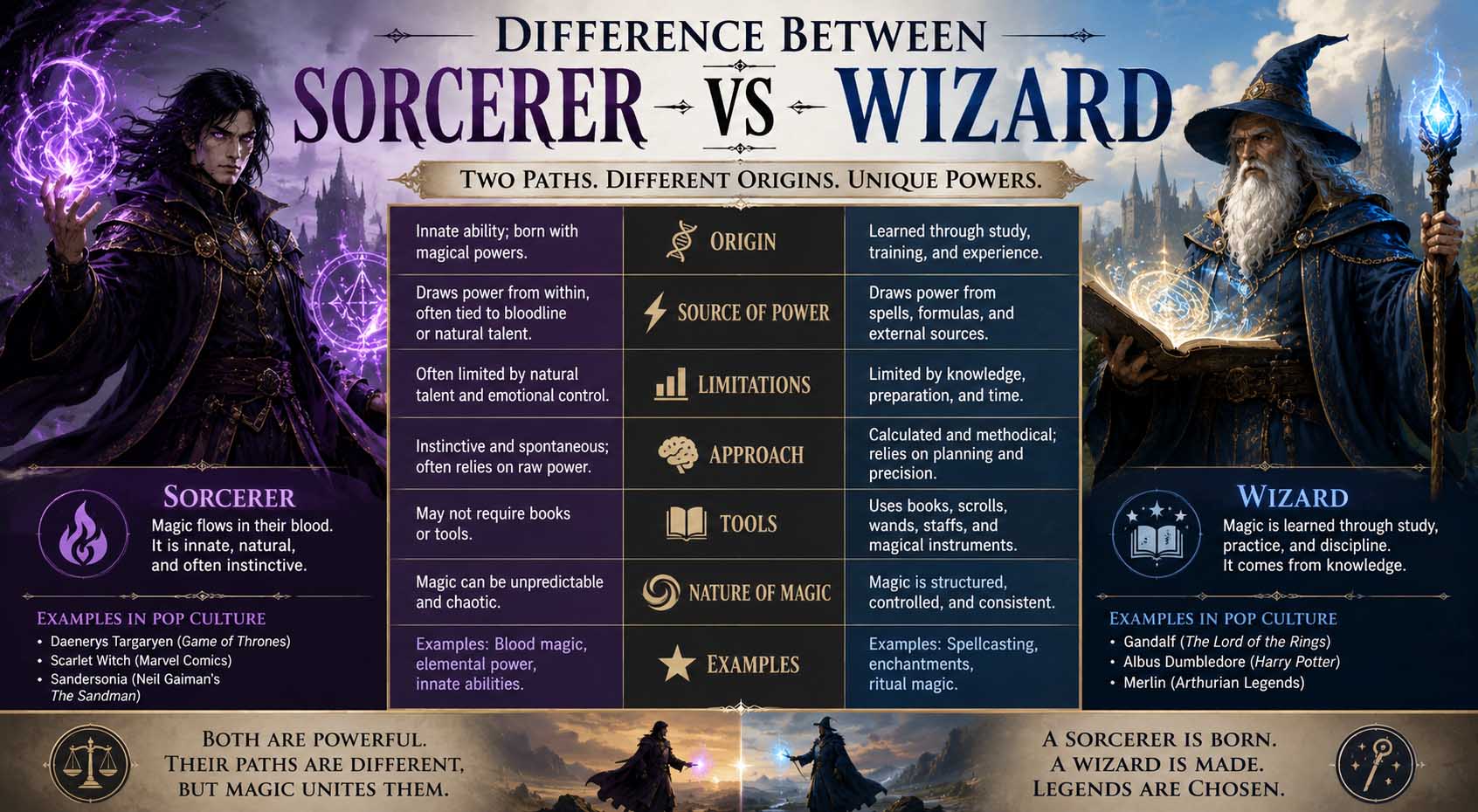
If you are choosing a spellcaster for a fantasy RPG, understanding the difference between sorcerer and wizard can save you from picking a class that does not match your playstyle. Both characters can throw powerful spells and control encounters, yet they usually gain and use magic in very different ways. A sorcerer relies on innate magical power, while a wizard develops magic through study, preparation, and arcane knowledge.
That basic distinction shapes almost everything else. Sorcerers usually work with a smaller selection of spells but can manipulate their magic in flexible ways. Wizards, meanwhile, tend to have access to a much broader magical toolbox.
The exact mechanics vary between games and rulesets. However, the sorcerer-versus-wizard concept remains useful across Dungeons & Dragons and many fantasy RPGs.
What Is the Difference Between Sorcerer and Wizard?
The simplest difference is where their magical ability comes from and how they manage it.
A sorcerer usually possesses magic naturally. Their power might come from ancestry, exposure to supernatural energy, or another extraordinary event. As a result, casting magic feels like an extension of the character.
A wizard, by contrast, learns magic. Wizards traditionally spend years studying spells, magical theory, symbols, rituals, and arcane formulas. Their spellbook represents that accumulated knowledge.
Here is a quick comparison:
| Feature | Sorcerer | Wizard |
|---|---|---|
| Source of magic | Innate power | Study and learning |
| Typical casting ability | Charisma | Intelligence |
| Spell selection | Usually smaller | Usually much larger |
| Signature mechanic | Metamagic | Spellbook/preparation |
| Preparation | Less complicated | More planning-focused |
| Flexibility | Flexible casting techniques | Flexible spell selection |
| Beginner learning curve | Moderate | Moderate to high |
| Typical fantasy identity | Natural magic user | Arcane scholar |
Players exploring the broader types of dnd characters will notice that these two classes can fill similar party roles while still feeling very different during character creation and play.
How Sorcerers Use Magic
Sorcerers do not usually need years of academic training to become magical. Instead, magic forms part of who they are.
In D&D, that idea appears through the Sorcerous Origin or subclass concept, depending on the edition or rules version being played. A character’s power may have connections to dragons, strange magical forces, unusual bloodlines, or other supernatural influences.
This origin also creates plenty of role-playing opportunities.
For example, your character might be frightened by powers they never requested. Another sorcerer might see natural magic as a gift and build their entire personality around mastering it.
Mechanically, sorcerers tend to know fewer spells than wizards. Therefore, spell selection matters because every choice needs to contribute something useful to your build.
However, sorcerers compensate through another major feature: Metamagic.
Metamagic Is the Sorcerer’s Big Advantage
Metamagic allows sorcerers to alter aspects of their spells.
Depending on the rules being used, Metamagic options can change a spell’s range, affect how it targets creatures, modify casting conditions, or provide other tactical advantages.
Consequently, two characters casting the same basic spell may use it differently.
This feature makes the sorcerer appealing to players who enjoy specializing. Instead of collecting a huge number of situational spells, you can learn a focused group and become highly effective at using them.
Still, limited spell choices can punish poor planning. Therefore, beginners should avoid choosing several spells that perform nearly identical jobs.
A balanced selection usually feels better during actual gameplay.
How Wizards Approach Spellcasting
Wizards represent the opposite philosophy.
Rather than relying primarily on natural talent, they build magical power through knowledge. Their spellbooks allow them to maintain a potentially broad collection of spells, although the exact preparation and casting rules depend on the edition or game.
This creates one of the wizard’s biggest strengths: versatility.
Suppose your party knows that tomorrow’s adventure involves exploring an abandoned magical tower. A wizard may prepare spells suited to investigation, defense, movement, or magical threats.
Later, when the campaign moves into a different environment, the wizard can adjust the prepared toolkit.
Therefore, wizards reward players who like thinking ahead.
They can be excellent battlefield controllers, damage dealers, utility casters, investigators, or support characters depending on their spell choices.
Difference Between a Sorcerer and a Wizard in Combat
At first glance, combat can make the two classes look almost identical. Both may stand behind tougher party members while casting spells.
However, their decision-making differs.
Sorcerers often ask:
How can I get the most value from the spells I already know?
Wizards tend to ask:
Which spell from my available toolkit best solves this problem?
That difference becomes more noticeable as characters gain levels and encounter increasingly varied challenges.
For instance, a sorcerer built around a carefully selected combat strategy may execute that plan very efficiently. Meanwhile, a wizard with the right spell prepared may have an answer for an unusual enemy or environmental obstacle.
Neither approach is automatically stronger. Instead, each rewards a different kind of player.
Spell Selection: Focused Power vs. Large Toolbox
Spell selection is probably the biggest practical distinction new players will feel.
Sorcerers normally operate with fewer known spells. Therefore, each selection should serve a clear purpose.
You might choose:
- a reliable damage option
- a defensive spell
- an area-control spell
- a mobility option
- a utility spell
That approach reduces situations where several known spells compete for exactly the same role.
Wizards generally have more room to collect options. Consequently, they can prepare different combinations based on expected challenges.
However, having more choices also means more reading.
A new wizard player may spend considerable time comparing spell descriptions before each session. Some players love that process, while others find it slows character management.
Wizard vs. Sorcerer Ability Scores
Another major difference between wizard and sorcerer builds is their primary spellcasting ability.
Traditionally, sorcerers rely on Charisma.
That can create useful synergy with social skills, depending on your build and proficiency choices. Therefore, a sorcerer may naturally fit a character who negotiates, persuades, intimidates, or otherwise takes an active role during social encounters.
Wizards traditionally rely on Intelligence.
As a result, wizard characters often fit naturally with knowledge-oriented skills. This reinforces the fantasy of an educated arcane specialist who solves problems through research and expertise.
Your ability scores also affect other character-building decisions. Therefore, decide early whether you want your character’s identity centered around force of personality or intellectual mastery.
DnD Difference Between Sorcerer and Wizard for Beginners
For beginners, neither class is automatically the correct choice.
A sorcerer can initially seem simpler because there are fewer spells to manage. However, choosing those spells carefully matters more because replacing a weak selection may not always be convenient.
Wizards have more options, which can make them forgiving in a different way. If you acquire several useful spells, you can change your prepared selection to match new situations.
On the other hand, managing a large spellbook can feel overwhelming.
Choose sorcerer if you like having a defined magical identity and learning how to use a smaller toolkit extremely well.
Choose wizard if you enjoy researching abilities, planning before encounters, and having many potential solutions available.
Which Class Offers Better Role-Playing?
Both offer excellent role-playing opportunities, although their themes are different.
A sorcerer’s story can focus on discovering where their magic came from. Perhaps the character inherited mysterious abilities or experienced an event that permanently changed them.
That raises interesting questions. Does the character enjoy having magic? Do other people fear it? Can they fully control it?
A wizard’s story can focus on ambition, curiosity, education, or obsession.
Perhaps the character became an adventurer because ordinary libraries no longer contain the knowledge they seek. Alternatively, they may hunt forgotten spellbooks and ancient magical secrets.
These themes can also influence equipment. While casters rarely depend on conventional weapons as heavily as martial characters, understanding types of weapons fantasy can help when choosing backup equipment or designing a character whose magical identity includes enchanted blades, staffs, or other fantasy gear.
Sorcerer vs. Wizard Strengths and Weaknesses
Neither class wins every category.
Sorcerer strengths
Sorcerers can offer highly flexible spell execution through class-specific mechanics such as Metamagic. They also support focused builds well because players can design their spell choices around a specific combat or role-playing concept.
Their Charisma focus can also complement a socially capable character.
Sorcerer weaknesses
A smaller selection of known spells means mistakes during character building can feel more noticeable.
Likewise, a highly specialized sorcerer may struggle when an encounter falls outside the situations their spell selection handles well.
Wizard strengths
Wizards are famous for versatility.
Given access to useful spells and enough preparation, they can adapt to combat, exploration, investigation, defense, movement, and utility situations.
Their broad magical identity also supports many different character concepts.
Wizard weaknesses
More options create more complexity.
Players need to understand numerous spells, think about preparation, and decide which tools are worth carrying into upcoming encounters.
Wizards can also feel less effective when the player prepares for the wrong situation.
What Is the Difference Between a Wizard and a Sorcerer Outside Combat?
The distinction becomes especially interesting when swords are put away.
Wizards often shine when magical utility and knowledge matter. Their broad spell access may help with exploration, investigation, travel, communication, or unusual environmental challenges.
Sorcerers can still contribute strongly outside combat. However, because they normally know fewer spells, selecting too many combat-only options can reduce their utility.
Their Charisma focus may compensate by supporting social interaction.
For example, a sorcerer might handle negotiations while a wizard examines magical writing discovered inside an ancient ruin.
Good party composition lets both classes contribute without competing for exactly the same role.
Common Mistakes When Choosing Sorcerer or Wizard
One mistake is assuming that sorcerers are simply easier wizards.
They are not.
Although both cast arcane magic, their resource management and character-building priorities differ.
Another mistake is choosing spells entirely around maximum damage. Damage matters, yet defensive, control, mobility, and utility spells can solve encounters that raw damage cannot.
Likewise, wizard players sometimes collect huge numbers of spells without learning what their core options actually do.
A smaller group of well-understood spells often works better than constantly stopping the game to read every available description.
Finally, avoid choosing purely from online rankings. A theoretically powerful build may feel boring if its gameplay does not suit you.
Difference Between Wizard and Sorcerer: Which Should You Pick?
Choose a sorcerer if you prefer a focused spell list, innate magical flavor, Charisma-based casting, and the ability to modify how spells work through signature class mechanics.
Choose a wizard if you prefer collecting spells, preparing for different situations, Intelligence-based casting, and having a broad magical toolbox.
For players who enjoy optimizing a small number of reliable options, sorcerer can feel satisfying.
Meanwhile, players who enjoy preparation and tactical flexibility may prefer wizard.
FAQs About Sorcerers and Wizards
Are sorcerers and wizards the same thing?
No. Although both are magic-using character types, their sources of power and gameplay mechanics usually differ. Sorcerers typically possess innate magic, while wizards learn magic through study.
Whats the difference between 14k and 18k gold?
This is unrelated to fantasy spellcasting. For gaming purposes, the relevant comparison is between sorcerer and wizard classes and how their spell systems work.
Is a wizard stronger than a sorcerer?
Not automatically. Strength depends on the game, ruleset, character level, subclass, build, encounter, and player decisions. Wizards often offer broader versatility, while sorcerers can excel through focused spell choices and Metamagic.
Which class is easier for a new D&D player?
Sorcerers have fewer spells to manage, although those choices carry more weight. Wizards offer more flexibility but require more spell management. Therefore, the easier option depends on whether you prefer specialization or preparation.
Can a character be both a wizard and a sorcerer?
In D&D rulesets that support multiclassing, a character may be able to take levels in both classes if the relevant requirements are met. However, multiclass spellcasting can become more complicated, so beginners may prefer learning one class first.
Pick the Magic Style You Actually Enjoy
The difference between sorcerer and wizard matters less as a question of which class is universally stronger and more as a question of how you want to play.
Sorcerers turn a focused collection of magic into a personalized toolkit. Wizards gain strength from knowledge, preparation, and access to many possible solutions.
Therefore, choose based on the gameplay loop you find enjoyable. If spontaneous, specialized magic sounds exciting, start with sorcerer. If collecting spells and preparing the perfect answer sounds more satisfying, wizard is likely the better choice.
Either way, learning your core spells and understanding your party’s needs will usually improve your experience more than simply copying the highest-ranked build.