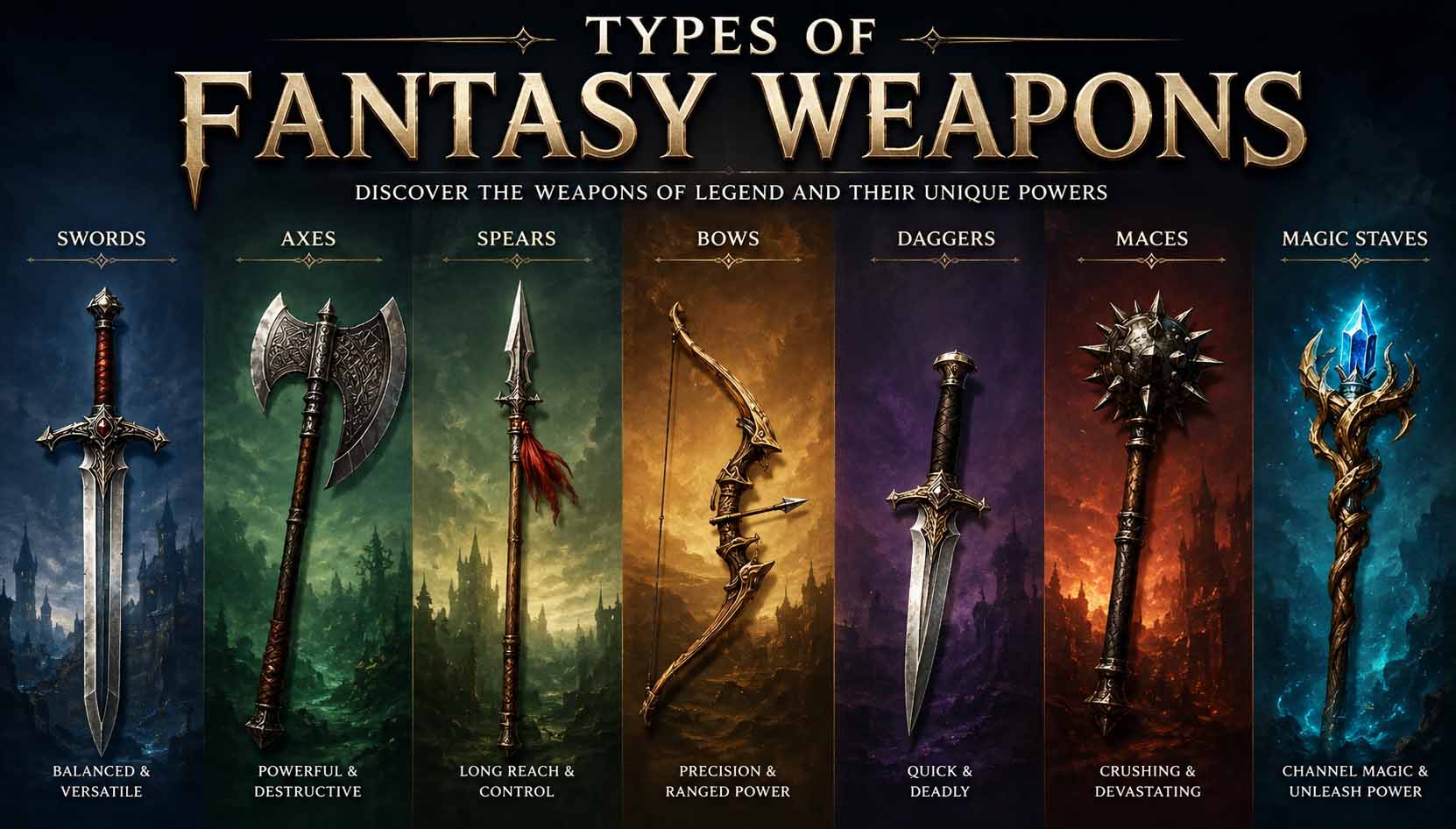
Walk into almost any fantasy RPG and one of your first big choices involves your weapon. Do you want the speed of twin daggers, the reach of a spear, the raw impact of a huge axe, or the magical flexibility of a staff? The many types of weapons fantasy games offer can change how a character moves, fights, builds stats, and approaches enemies.
Although exact mechanics vary between games, fantasy weapons usually fall into recognizable families. Swords favor versatility, bows provide range, heavy weapons trade speed for impact, while magical weapons often support spells or elemental damage. Some games then add enchanted, legendary, or completely fictional weapons that ignore real-world limitations.
Knowing these categories makes it easier to understand loot, plan builds, and choose equipment that actually matches your playstyle.
Quick Guide to the Main Types of Weapons Fantasy Games Feature
Fantasy games can contain dozens or even hundreds of individual weapons. However, most fit into a smaller set of broad categories.
| Weapon Type | Typical Strength | Common Playstyle |
|---|---|---|
| Swords | Balanced performance | Versatile melee |
| Daggers | Speed and mobility | Assassin or rogue |
| Axes | Strong strikes | Aggressive melee |
| Maces/Hammers | Heavy impact | Tank or warrior |
| Spears/Polearms | Reach | Controlled melee |
| Bows | Long-range attacks | Ranger |
| Crossbows | Powerful ranged shots | Precision ranged |
| Staffs | Magic support | Mage or caster |
| Wands | Fast spellcasting | Magic DPS/support |
| Shields | Defense | Tank or defensive fighter |
| Magical weapons | Special effects | Hybrid/specialized builds |
| Exotic weapons | Unique mechanics | Advanced or unusual builds |
The best option depends on the game’s combat system. Therefore, weapon statistics alone rarely tell the whole story.
Attack speed, range, stamina cost, abilities, scaling, critical chance, status effects, and character class can all matter.
Swords: The Classic Fantasy Weapon
Few weapons are more closely associated with fantasy games than swords.
Developers often make swords beginner-friendly because they provide a comfortable balance between damage, reach, and speed. As a result, they frequently work with several character builds rather than forcing players into one specialized style.
One-Handed Swords
One-handed swords usually prioritize flexibility.
A character may combine one with a shield, magical focus, dagger, or second sword. Consequently, these weapons can work well for players who want reliable melee attacks without sacrificing mobility.
Sword-and-shield setups commonly favor defensive fighters. Meanwhile, dual-wield builds may emphasize rapid attacks or critical damage.
The exact setup often depends on character archetype. Players comparing types of dnd characters, for example, will notice that weapon choice can be closely connected with class abilities, proficiencies, attributes, and role-playing style.
Greatswords
Greatswords exchange some speed for greater reach and heavier attacks.
They often suit warriors who can survive long attack animations and capitalize on openings. However, they may feel awkward for players who prefer quick dodges and rapid combinations.
In action RPGs, timing usually matters just as much as raw weapon damage.
Daggers and Short Blades
Daggers are built around speed.
Rogues, assassins, thieves, and other agile characters commonly use them. In many games, daggers receive bonuses for critical hits, stealth attacks, backstabs, or rapid status buildup.
Their biggest weakness is usually limited reach.
Because you must fight close to enemies, positioning becomes essential. However, experienced players can sometimes turn that limitation into an advantage by staying inside the effective range of slower opponents.
Dual daggers may also produce extremely fast attack chains.
Still, do not assume faster automatically means stronger. Damage per second depends on the complete build, including stats, abilities, buffs, enemy defenses, and weapon upgrades.
Axes and Battle Axes
Axes usually represent a more aggressive alternative to swords.
One-handed axes may offer a balance between speed and heavy damage, while two-handed battle axes often emphasize powerful individual strikes.
Some fantasy games also associate axes with bleeding, armor damage, or execution-style abilities.
However, those effects are game-specific rather than universal.
When an Axe Build Makes Sense
Choose an axe when your build rewards aggressive melee combat and you are comfortable committing to attacks.
Heavy axes can work especially well against slower enemies because their openings are easier to predict.
Against quick opponents, though, long attack animations can become a disadvantage.
Therefore, check the full moveset before judging an axe by its damage number alone.
Maces, Clubs and War Hammers
Sometimes you do not need an elegant blade.
Fantasy warriors frequently carry maces, clubs, mauls, and enormous war hammers designed around heavy impact.
These weapons often appear in strength-focused builds. Depending on the game, they may perform well against armored enemies, cause stagger, or provide strong knockback.
Two-handed hammers tend to be especially slow. However, landing a successful charged attack can feel extremely rewarding.
They can also pair naturally with tank-like characters who have enough defense to withstand pressure while preparing slower attacks.
Spears, Lances and Polearms
Players often overlook reach when comparing different types of weapons fantasy games provide.
A spear demonstrates why range matters.
Spears, pikes, halberds, glaives, and similar polearms allow players to threaten enemies while maintaining more distance than most sword users.
This can make them excellent for controlled melee combat.
Spears
Spears usually specialize in thrusting attacks and straight-line reach.
They can work well in narrow spaces because the player does not always need room for wide swings.
Halberds and Glaives
Halberds and glaives combine long handles with larger blades.
As a result, their movesets may include both thrusting and sweeping attacks.
Some games give polearms strong crowd-control potential, although their slower recovery can punish poorly timed attacks.
Bows and Ranged Fantasy Weapons
Not every hero wants to fight a dragon from five feet away.
Bows let players engage enemies from a safer distance and often reward precision.
Common fantasy bow categories include:
- Shortbows
- Longbows
- Recurve-style bows
- Magical bows
- Elemental bows
Ranged builds may depend heavily on accuracy, ammunition, positioning, or resource management.
Meanwhile, some RPGs allow players to switch between special arrow types for different enemies.
Crossbows and Heavy Ranged Weapons
Crossbows often occupy a different role from traditional bows.
While bows generally allow faster, repeated attacks, crossbows typically have slower firing or reload mechanics in exchange for more powerful individual shots.
That tradeoff can suit players who prefer deliberate ranged combat.
Heavy fantasy crossbows may also function almost like portable siege weapons.
Still, mobility can suffer when a game requires long reload animations. Therefore, positioning before firing becomes especially valuable.
Magical Types of Weapons in Fantasy
Magic allows game designers to move beyond conventional weapon categories.
A magical weapon might behave like a normal sword until its special ability activates. Another may launch projectiles, transform between forms, summon creatures, or scale primarily with magical attributes.
This variety is one reason fantasy loot systems can become so complex.
In games built around equipment rankings, players sometimes compare items by overall effectiveness, much like a radiant item tier list organizes gear according to relative value within its own game’s mechanics.
However, tier placement should never completely replace build testing. A highly ranked weapon may perform poorly if your character lacks the stats or abilities needed to use it properly.
Staffs, Wands and Magical Focuses
Staffs and wands usually serve spellcasting characters.
Rather than dealing most of their damage through physical strikes, these weapons may increase spell power, unlock magical abilities, restore resources, or modify elemental effects.
Staffs
Staffs commonly support powerful spells or provide strong magical bonuses.
Depending on the game, you might encounter fire, frost, lightning, healing, necromancy, or summoning staffs.
Wands
Wands are often lighter and faster.
Some games treat them as basic ranged magical weapons, while others use them as tools that modify traditional spellcasting.
Therefore, always check how the specific game’s magic system works before investing upgrade materials.
Shields as Defensive Weapons
A shield is technically defensive equipment in many games, yet it can also become part of an offensive playstyle.
Players may use shields to block attacks, parry enemies, stagger opponents, or perform shield-bash abilities.
Some fantasy RPGs even include spiked, magical, or oversized shields built specifically for attacking.
Sword-and-shield combinations work well for beginners because blocking can provide another option when dodging feels difficult.
However, shields may consume stamina or another defensive resource. Holding block constantly can therefore leave you vulnerable once that resource runs out.
Elemental and Enchanted Weapons
Fantasy weapons become more interesting when enchantments enter the system.
A basic sword might deal physical damage, while its enchanted version could apply fire, frost, lightning, poison, holy, shadow, or another fictional damage type.
The strongest element usually depends on the enemy.
For instance, a fire weapon may perform extremely well against one creature and poorly against another with fire resistance.
That makes maintaining multiple weapon options useful in games with meaningful elemental weaknesses.
Players familiar with character-focused rankings such as a raid champion tier list will recognize the same basic principle: effectiveness depends heavily on the encounter, team composition, role, and underlying game mechanics rather than one number in isolation.
Exotic and Fictional Fantasy Weapons
Fantasy settings are not restricted by real-world weapon design.
Developers can create almost anything.
You may encounter:
- Double-bladed swords
- Chain blades
- Magical chakrams
- Gunblades
- Scythes
- Floating weapons
- Spellbooks
- Crystal weapons
- Transforming blades
- Summoned weapons
- Living weapons
These are some of the most memorable different types of fantasy weapons because they can introduce mechanics that conventional equipment cannot provide.
A transforming weapon, for example, might switch between a fast blade and a heavy hammer. Meanwhile, a floating magical weapon could attack independently while the player casts spells.
Exotic weapons are often harder to master because their movesets behave differently from familiar swords and bows.
How to Choose the Right Fantasy Weapon
Start with your preferred combat style rather than chasing the weapon with the biggest damage number.
If you enjoy fast movement, consider daggers, light swords, or similar agile weapons.
If you prefer heavy hits, axes, greatswords, and hammers may feel better.
Meanwhile, bows suit players who enjoy ranged positioning, while staffs and magical focuses make more sense for spell-based characters.
Then check how the weapon scales.
Many RPGs tie weapon performance to attributes such as strength, dexterity, intelligence, faith, or their fictional equivalents.
A powerful strength weapon may therefore perform badly on a character built entirely around magic.
Next, inspect the moveset.
Two weapons with similar statistics can feel completely different because one attacks vertically while another provides broad sweeping strikes.
Finally, consider upgrade costs. Rare materials can be limited, so avoid fully upgrading every new weapon before testing whether you actually enjoy using it.
Common Weapon-Build Mistakes
A frequent beginner mistake is selecting equipment based only on displayed attack power.
Higher damage does not automatically mean better performance.
A slower weapon may deliver larger individual hits but lower practical damage if enemies repeatedly interrupt you.
Another mistake is ignoring range. Even a modest damage advantage may not compensate for constantly missing enemies because your weapon is too short.
Players also sometimes spread upgrade materials across too many weapons. Unless the game provides abundant resources, focusing on a small selection can make progression easier.
Finally, avoid copying high-level builds without understanding them. Endgame equipment may depend on skills, stat thresholds, upgrades, or bonuses you have not unlocked yet.
FAQs About Types of Fantasy Weapons
What Are the Most Common Types of Fantasy Weapons?
Swords, daggers, axes, hammers, spears, bows, crossbows, staffs, wands, and shields are among the most common categories. Fantasy games also frequently include magical and completely fictional weapons.
What Is the Best Fantasy Weapon?
There is no universal best weapon. The right choice depends on the game, character build, enemy, combat system, and player preference.
Which Fantasy Weapon Is Best for Beginners?
One-handed swords are often beginner-friendly because many games give them balanced speed, damage, and reach. Sword-and-shield setups can also provide useful defensive options.
Are Magical Weapons Better Than Normal Weapons?
Not automatically. Magical weapons may provide useful elemental effects or special abilities, but normal weapons can outperform them with the right upgrades and character build.
What Weapons Do Fantasy Mages Use?
Staffs and wands are common, although some fantasy games let mages use spellbooks, enchanted swords, magical focuses, or summoned weapons.
Build Around How You Like to Play
The huge number of types of weapons fantasy games offer can make choosing equipment seem complicated at first. However, the decision becomes easier once you focus on playstyle, range, attack speed, scaling, moveset, and special effects rather than damage numbers alone.
Try several weapon families before committing valuable upgrade materials. A popular greatsword may look powerful, yet you might perform far better with a spear or fast dagger because its timing matches the way you naturally play.
Fantasy games are at their best when equipment changes how combat feels. So experiment with different weapon classes, learn their strengths and weaknesses, and build around the weapon that makes every fight more enjoyable