
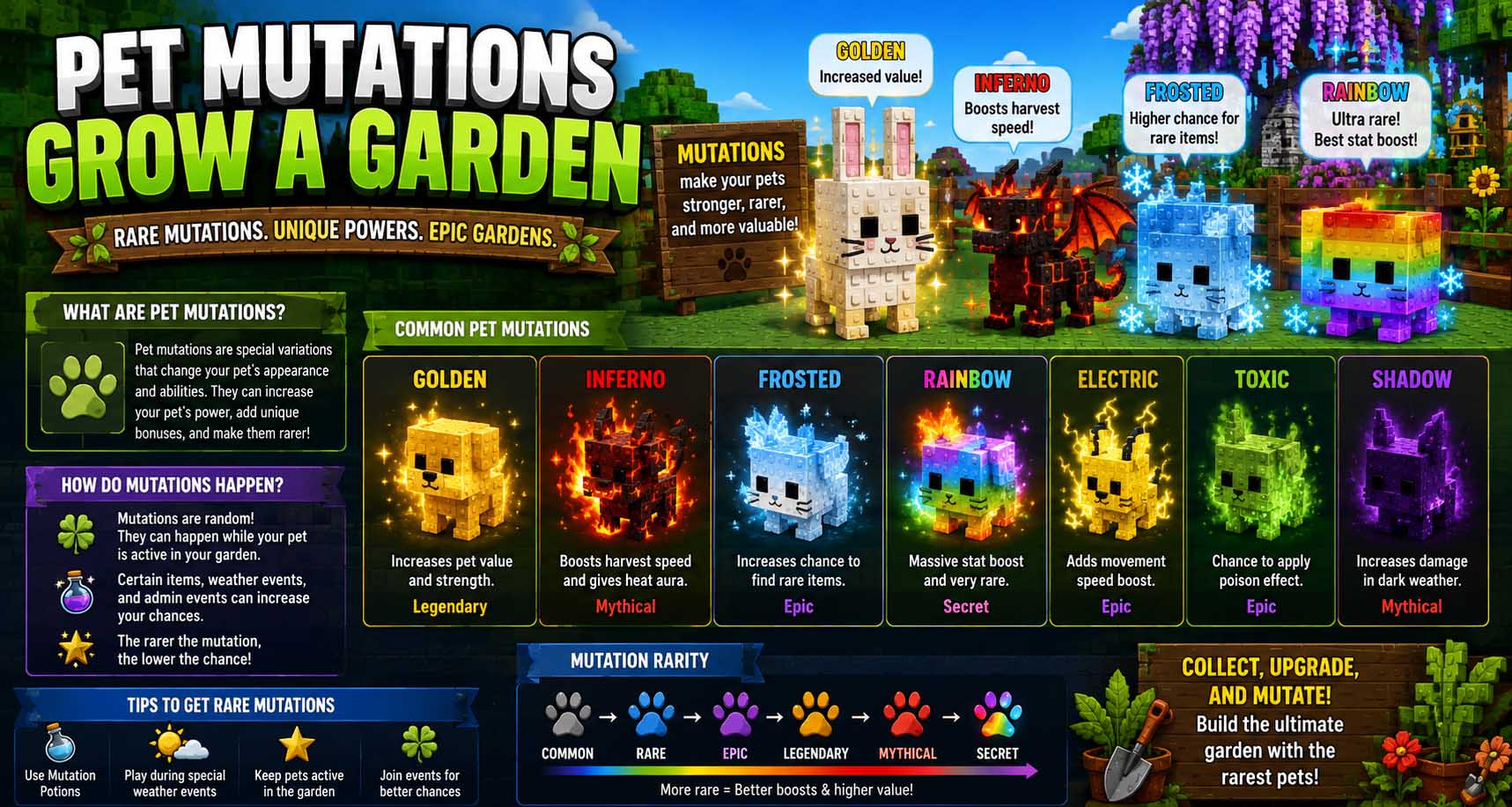
If you have started building a serious pet collection, pet mutations Grow a Garden mechanics can make your companions much more interesting. Mutations can change a pet’s appearance, improve XP-related performance, enhance passive abilities, alter size, or even help apply mutations to crops. However, the system has expanded through updates, so returning players may find it more complicated than they remember.
The key is to stop thinking of every mutation as a simple rarity upgrade. Instead, the best mutation depends on what you want a particular pet to accomplish. An XP-focused mutation may be useful while developing pets, while another mutation may fit a powerful passive ability or crop-focused strategy better.
Because Grow a Garden receives regular updates, exact mutation availability, effects, and acquisition methods can change. Therefore, always check the current in-game descriptions before spending valuable resources on a high-value pet.
What Are Pet Mutations in Grow a Garden?
Pet mutations are special modifiers applied to pets. Depending on the mutation, they can affect XP gain, passive performance, hunger, size, ability behavior, or interactions with crops.
This system is separate from crop mutations. A crop mutation mainly changes a plant or its value, while a pet mutation changes the companion itself or gives that companion an extra effect.
That distinction matters because players sometimes see a mutated pet and assume its only benefit is higher trading value. In practice, some mutations have genuine gameplay utility.
For example, Shiny is associated with improved pet XP gain, while Inverted offers a stronger XP-related effect. Other mutations can change a pet’s size or improve its passive performance. Meanwhile, certain mutations can cause the pet to interact with nearby fruit.
If you are still deciding which companions deserve your resources, comparing the best pets in grow a garden first can help. A strong mutation is usually more useful when it complements a pet that already serves an important role in your setup.
How Do Pet Mutations Grow a Garden Mechanics Work?
The basic process revolves around developing a pet and then using the game’s available mutation systems. Historically, the Mutation Machine has been one of the main ways to mutate eligible pets, while Mutation Shards and special pet or event mechanics can provide other mutation routes.
Level or age your pet first
Pet age represents progression rather than real-world age. As a pet gains XP, its age increases and progression systems become available.
The Mutation Machine has traditionally required a sufficiently aged pet, with Age 50 being a key threshold in the mutation system. However, later updates have expanded pet progression, so players should follow the requirement displayed by the current version of the machine rather than relying entirely on an older guide.
That makes XP management valuable. If you mutate every pet without a plan, you can spend a lot of time developing companions that never become part of your main garden setup.
Use the appropriate mutation method
Once your pet meets the required conditions, you can use the available mutation mechanic and receive an eligible result.
However, the result is not simply a permanent upgrade that stacks endlessly. Standard Mutation Machine mutations generally replace an existing mutation rather than stacking another standard mutation on top of it.
As a result, rerolling a good mutation can be risky. Before trying again, compare the existing effect with what you are actually hoping to obtain.
What Do Pet Mutations Do in Grow a Garden?
The answer depends heavily on the mutation.
Some mutations help pets gain XP faster. Others strengthen passive abilities, alter physical size, affect hunger, or allow pets to influence nearby crops. Because those effects solve different problems, there is no single mutation that automatically wins in every situation.
A simple way to think about the system is by role:
| Mutation role | Main purpose | Useful for |
|---|---|---|
| XP-focused | Improves pet progression | Leveling pets |
| Passive-focused | Enhances pet abilities | Strong ability pets |
| Crop-focused | Helps apply effects to fruit | Farming setups |
| Size-focused | Changes pet size and related behavior | Specialized builds |
| Utility-focused | Changes hunger or other mechanics | Longer sessions |
For instance, Shiny and Inverted are primarily associated with XP improvement. Meanwhile, Mega makes the pet much larger and changes its hunger behavior while providing XP benefits. Tiny takes the opposite approach by reducing size and slowing hunger consumption.
Therefore, asking what do pet mutations do in Grow a Garden is only the first step. The better question is what a particular mutation does for your particular pet.
Grow a Garden Pet Mutations Worth Understanding
The mutation pool has changed considerably as Grow a Garden has evolved. Consequently, older lists may show far fewer mutations than newer databases.
For example, recent 2026 community databases contain dozens of pet mutations, while older guides describe a much smaller pool. This difference is one reason you should avoid treating an old “all pet mutations Grow a Garden” list as permanently complete.
Still, several well-known mutation types make the overall system easier to understand.
Shiny and Inverted
Shiny is a common XP-oriented mutation, while Inverted provides a larger XP boost. Therefore, both can make sense when pet development is your main priority.
They may not always be the most desirable endgame choices, though. Once a pet reaches your target progression level, a mutation that directly improves its practical role can become more appealing.
Frozen and Windy
These mutations show why pet mutations are not limited to pet stats.
Frozen can periodically give nearby fruit a chance to become Frozen, while Windy can similarly interact with fruit through Windstruck. Therefore, these mutations can contribute directly to crop-focused strategies instead of simply changing the pet.
This distinction becomes especially useful when comparing grow a garden value strategies. A pet’s contribution to your garden can matter more than an impressive-looking mutation alone.
Mega and Tiny
Mega dramatically increases pet size and changes hunger behavior, while Tiny makes the pet smaller and reduces hunger consumption. Both also have XP-related effects according to current mutation references.
Neither should automatically be considered better. Instead, choose based on your setup and the specific pet receiving the mutation.
Passive-enhancing mutations
Some mutations focus on strengthening what a pet already does. These become particularly interesting on companions whose base passive is already valuable.
Therefore, before rerolling a rare pet, read both its original ability and the mutation effect. That small check can prevent you from replacing a useful combination simply because another mutation appears rarer.
Choosing Mutations Based on Your Goal
Instead of chasing rarity alone, decide what role you need to improve.
For XP progression, prioritize mutations that help the pet develop efficiently. Meanwhile, for crop farming, look at mutations that interact with fruit or complement other crop-mutation sources.
Likewise, if trading is your main interest, gameplay strength is only part of the picture. The grow a garden pet value of a mutated companion can depend on the pet itself, its weight or progression, current demand, mutation desirability, and the constantly changing player market.
Because of that, never assume a rare mutation automatically creates a fixed trade value. Player demand can move quickly after updates.
Which Pets Should You Mutate First?
Start with pets you actually expect to use.
For example, if a pet already contributes strongly to your farming strategy, improving that companion generally makes more sense than spending resources on a weak pet just because it is available.
You should also consider how the mutation interacts with the pet’s base passive. A mutation that strengthens passive performance becomes much more attractive when the original ability is already useful.
The same principle applies when evaluating specialized companions such as bear bee grow a garden. First understand what the pet contributes naturally; then decide whether investing in mutation progression supports that role.
For beginners, this approach also keeps resource use under control. Instead of mutating everything, build a small core lineup and improve it gradually.
Grow a Garden Pet Mutations Update Changes Matter
The Grow a Garden pet mutations update history matters because the system is no longer as simple as some early guides suggest.
Newer community databases list far more mutation types than older references, while player reports in 2026 also describe expanded pet-age and progression mechanics. Therefore, exact mutation counts can become outdated quickly.
This is especially relevant when searching for a complete mutation list. A guide published months ago may still explain the basic mechanic correctly while missing newer mutation sources or effects.
For that reason, use evergreen strategy for decision-making but current in-game information for exact numbers.
Advanced Mutation Strategy for Experienced Players
Once you have several developed pets, mutation planning becomes less about obtaining a mutation and more about obtaining the right combination of pet and mutation.
First, identify your pet’s job. Is it there for crop mutations, cooldown support, XP progression, passive output, or another specialized purpose?
Next, determine whether the mutation strengthens that job. If it does not, rarity alone may not justify keeping it.
Then consider opportunity cost. Rerolling means risking your current result, while developing another copy of the pet may take significant time and resources.
For example, players interested in a queen bee grow a garden setup should evaluate the pet’s core utility before deciding whether a particular mutation genuinely improves the role they want it to perform.
Finally, avoid applying your best resources to a pet simply because it is currently popular. Balance changes, events, and new pets can shift the meta.
Common Pet Mutation Mistakes
One of the biggest mistakes is assuming every mutation is an upgrade. Some effects fit specific pets much better than others, so blindly rerolling can leave you with a less useful combination.
Another mistake is confusing pet mutations with crop mutations. Although some mutated pets can affect crops, the two systems serve different purposes.
Players also sometimes use outdated mutation lists. Since Grow a Garden changes regularly, old rarity tables and mutation counts can quickly become unreliable.
Finally, avoid judging a mutation only by trade hype. A less fashionable mutation may provide much more practical value for your own farming setup.
Pet Mutations Grow a Garden FAQs
Can every pet get a mutation?
Mutation eligibility depends on the current mutation system, pet progression, and the method being used. The Mutation Machine has traditionally used an age requirement, while some mutations can come from other mechanics. Therefore, check the current in-game requirements before investing resources.
Do pet mutations stack?
Standard Mutation Machine mutations generally do not stack on the same pet. Applying another standard mutation can replace the existing one, so reroll carefully.
Are pet mutations the same as crop mutations?
No. Pet mutations modify companions or give them extra effects, whereas crop mutations modify plants and often affect crop value. However, certain pet mutations can help apply mutations to nearby fruit.
What is the best pet mutation?
There is no universal answer. The strongest choice depends on the pet, its ability, your farming strategy, and whether you care most about XP, crop effects, passive strength, convenience, or trading.
Should beginners chase rare mutations?
Usually, beginners benefit more from building a useful pet lineup first. Once you know which pets you regularly use, mutation resources become easier to spend wisely.
Build Your Mutation Strategy Around the Pet
The smartest way to approach pet mutations Grow a Garden gameplay is to match the mutation to the pet’s purpose. XP mutations can support progression, passive-focused mutations can strengthen useful companions, and crop-related effects can improve specialized farming setups.
At the same time, Grow a Garden keeps changing. Therefore, treat exact mutation pools, chances, and progression requirements as update-sensitive information, while using the broader strategy as your long-term guide.
Before rerolling a valuable pet, read its current ability, check its existing mutation, and decide what result would genuinely improve your setup. That simple habit can save resources and help you build a much more effective pet collection.