
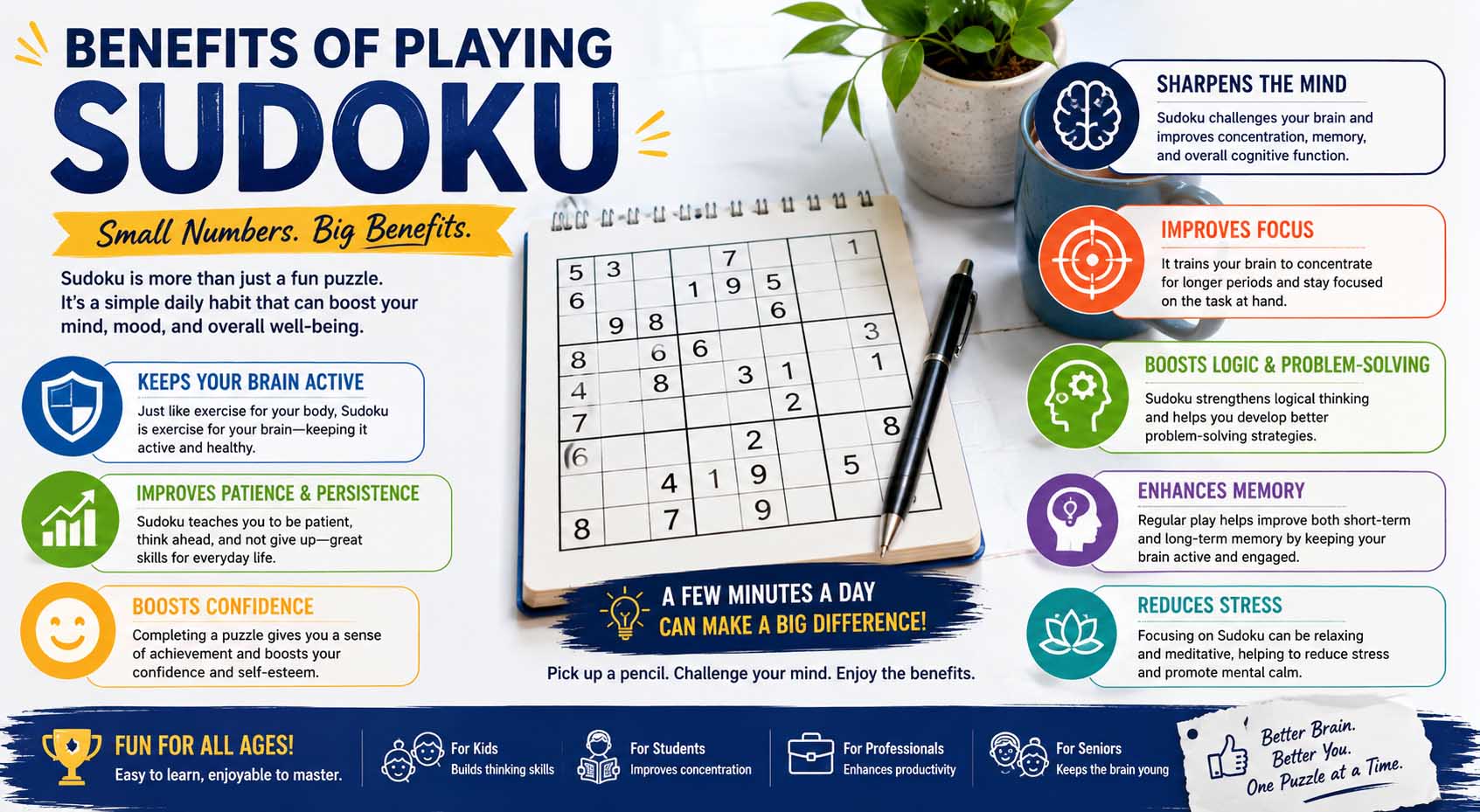
If you’ve ever wondered about the benefits of playing Sudoku, you’re not alone. This number puzzle has remained popular for decades because it’s easy to learn, challenging to master, and satisfying to solve. Whether you enjoy a quick puzzle during a coffee break or spend hours tackling expert grids, Sudoku offers an engaging mental workout without requiring expensive equipment or complicated rules.
Unlike games that rely on fast reflexes or luck, Sudoku rewards careful thinking, patience, and logical reasoning. That’s why players of all ages continue returning to it, both on paper and through mobile apps. In this guide, we’ll explore the biggest advantages of Sudoku, explain why millions of people enjoy it every day, and share practical tips for getting even more out of each puzzle.
Why Sudoku Is Still One of the Most Popular Puzzle Games
Sudoku first gained worldwide popularity through newspapers, but today it’s available almost everywhere.
You can play:
- Mobile apps
- Online puzzle websites
- Printed books
- Newspapers
- Gaming consoles
- Tablet apps
Its simple rules make it accessible, while increasing difficulty levels keep experienced players interested.
If you enjoy brain teasers in general, exploring different types of puzzles can help you discover other games that build similar logical thinking skills.
Benefits of Playing Sudoku Every Day
Many players ask about the benefits of playing Sudoku everyday because they enjoy making it part of their daily routine.
While Sudoku isn’t a guaranteed way to improve memory or prevent disease, it can provide an enjoyable mental challenge that encourages regular problem-solving and concentration.
Let’s look at some of its biggest advantages.
1. Improves Logical Thinking
Sudoku is built entirely around logic.
Unlike guessing games, every number has a correct location based on information already available.
Each puzzle encourages players to:
- Identify patterns
- Eliminate impossible options
- Think several moves ahead
Over time, these habits may strengthen logical reasoning during gameplay.
2. Encourages Better Concentration
Sudoku rewards focus.
One small mistake can affect several rows or columns later in the puzzle.
Players often find themselves concentrating for long periods while solving more difficult grids.
This focused attention is one reason many people enjoy Sudoku during quiet moments away from daily distractions.
3. Strengthens Problem-Solving Skills
Instead of relying on trial and error, experienced players learn to:
- Analyze possibilities
- Break large problems into smaller steps
- Test different logical paths
These skills improve naturally through regular practice.
4. Offers a Relaxing Gaming Experience
Not every game needs fast reactions or competitive multiplayer modes.
Sudoku provides a calm experience where players can work at their own pace.
Many people enjoy solving puzzles while listening to music or relaxing after work.
Its slower pace makes it a welcome change from action-heavy games.
5. Builds Patience
Expert Sudoku puzzles rarely have immediate solutions.
Instead, players learn to:
- Stay calm
- Recheck previous steps
- Continue making steady progress
Developing patience often becomes one of the most rewarding parts of mastering difficult puzzles.
6. Improves Pattern Recognition
As experience grows, players begin spotting familiar number arrangements almost instantly.
Recognizing these patterns helps solve puzzles faster and more accurately.
Pattern recognition becomes especially useful when tackling higher difficulty levels.
7. Gives a Sense of Achievement
Completing a difficult Sudoku puzzle feels rewarding.
Each solved grid represents:
- Careful thinking
- Persistence
- Logical planning
Many players enjoy keeping streaks or tracking how quickly they complete puzzles over time.
8. Easy to Play Anywhere
One reason Sudoku has remained popular is its flexibility.
You don’t need:
- Internet access
- Expensive hardware
- Long tutorials
- Gaming experience
A printed puzzle book or smartphone is often all you need.
When you’re looking for games to play when bored, Sudoku remains one of the easiest options because a single puzzle can take anywhere from a few minutes to well over an hour depending on the difficulty.
Benefits of Playing Sudoku for Brain Activity
Many people specifically search for the benefits of playing Sudoku for brain health.
Current research suggests mentally stimulating activities may help keep the brain active as part of an overall healthy lifestyle.
Sudoku encourages:
- Attention
- Working memory
- Logical reasoning
- Visual scanning
- Decision-making
However, it’s worth remembering that no puzzle alone has been proven to prevent dementia or other neurological conditions.
Regular physical activity, quality sleep, healthy nutrition, and social engagement also play important roles in long-term brain health.
Beginner Tips for Better Results
New players often improve quickly by following a few simple habits.
Start With Easy Puzzles
Beginner grids help you understand the solving process without becoming frustrated.
Confidence grows naturally before moving to harder levels.
Look for Obvious Numbers First
Instead of trying to solve the entire puzzle immediately, identify rows, columns, or boxes with only one missing number.
These easy wins create momentum.
Avoid Guessing
One of Sudoku’s biggest strengths is that every puzzle can be solved logically.
Guessing often creates mistakes that become difficult to correct later.
For more detailed solving methods, check out our collection of tips for Sudoku, which covers beginner and advanced techniques.
Take Breaks
If you’re stuck, stepping away for a few minutes often helps you notice patterns you previously missed.
Fresh eyes make a surprising difference.
Quick Summary Table
| Benefit | Why It Matters |
|---|---|
| Logical thinking | Encourages structured reasoning |
| Concentration | Helps maintain focus |
| Problem-solving | Builds analytical skills |
| Relaxation | Offers calm, pressure-free gameplay |
| Patience | Rewards persistence |
| Pattern recognition | Improves solving efficiency |
| Achievement | Creates satisfying progress |
| Accessibility | Easy to play almost anywhere |
These benefits explain why Sudoku continues attracting new players while keeping longtime fans engaged.
Sudoku Compared With Other Puzzle Games
Sudoku shares similarities with many other brain games, but it also stands apart.
Unlike crossword puzzles, Sudoku doesn’t rely on vocabulary.
Unlike jigsaw puzzles, it focuses entirely on logic.
Players who enjoy both numbers and language may also enjoy exploring various types of word puzzles, which challenge the brain in different ways while offering a similar sense of accomplishment.
9. Helps Develop Consistent Thinking Habits
One reason players stick with Sudoku is that it encourages a methodical approach.
Instead of jumping randomly around the grid, experienced solvers often develop a routine:
- Scan rows first.
- Check columns.
- Review each 3×3 box.
- Eliminate impossible numbers.
- Repeat until new opportunities appear.
Following a consistent process reduces mistakes and makes difficult puzzles feel more manageable.
10. Improves Attention to Detail
Missing a single number can create problems across several sections of the puzzle.
As a result, Sudoku naturally rewards careful observation.
Many experienced players become better at spotting small inconsistencies because they’re constantly checking every row and column for accuracy.
11. Encourages Strategic Planning
Easy puzzles often require straightforward logic.
Hard and expert puzzles demand something more.
Players frequently need to:
- Save possible candidates
- Plan several moves ahead
- Revisit earlier assumptions
- Work through multiple logical chains
These strategic habits make advanced Sudoku especially satisfying.
12. Provides Screen-Free Entertainment
Although many people enjoy digital Sudoku apps, the game also works perfectly on paper.
Printed puzzle books remain popular because they offer:
- No advertisements
- No notifications
- No internet connection
- Less screen time
For readers looking to reduce digital distractions, Sudoku is an excellent alternative.
13. Suitable for Almost Every Age
Children can start with simplified puzzles.
Adults enjoy increasingly difficult challenges.
Older players often appreciate Sudoku because the rules remain easy to remember while each puzzle still feels unique.
Very few games appeal to such a wide range of ages.
14. Endless Variety
Despite having simple rules, Sudoku rarely becomes repetitive.
Different difficulty levels create new experiences:
| Difficulty | Best For | Typical Experience |
|---|---|---|
| Easy | Beginners | Learn basic logic |
| Medium | Casual players | Balanced challenge |
| Hard | Regular players | Requires planning |
| Expert | Advanced solvers | Complex logical deductions |
Because millions of valid puzzle layouts exist, every game feels fresh.
15. Fun Without Competition
Many modern games revolve around rankings, online matchmaking, or seasonal events.
Sudoku offers something different.
You compete only against yourself.
You can improve:
- Completion time
- Accuracy
- Difficulty level
- Personal solving techniques
That makes progress feel rewarding without external pressure.
Common Mistakes That Slow Players Down
Even experienced players occasionally develop habits that make puzzles harder than they need to be.
Guessing Too Early
Guessing often creates chain reactions of incorrect numbers.
Whenever possible, rely on logical deduction instead.
Ignoring Candidate Numbers
Writing small candidate numbers helps organize possibilities.
This becomes especially valuable in difficult puzzles.
Rushing Through Easy Sections
Many mistakes happen because players enter obvious numbers too quickly without double-checking nearby rows and columns.
Slowing down often saves time later.
Skipping Simpler Opportunities
Before tackling difficult deductions, scan the puzzle again.
A single overlooked number may unlock several new moves.
Advanced Strategies for Experienced Players
Once you become comfortable with basic solving, advanced techniques make expert puzzles much more approachable.
Some popular methods include:
- Naked pairs
- Hidden pairs
- Pointing pairs
- Box-line reduction
- X-Wing
- Swordfish
You don’t need every advanced strategy immediately.
Learning one technique at a time makes progression much easier.
What Are the Benefits of Playing Sudoku Compared With Other Logic Games?
People often ask, what are the benefits of playing Sudoku compared with chess, crossword puzzles, or matching games.
Each game develops different skills.
| Game | Main Skill |
|---|---|
| Sudoku | Logical deduction |
| Crossword | Vocabulary |
| Chess | Long-term strategy |
| Kakuro | Mathematical reasoning |
| Nonograms | Visual logic |
Rather than replacing other puzzles, Sudoku complements them well.
If you’re interested in broader brain-training activities, our guide on the benefits of doing puzzles explains how different puzzle styles challenge different mental skills.
Is Playing Sudoku Every Day a Good Idea?
Many enthusiasts enjoy completing one puzzle daily.
The benefits of playing Sudoku daily come from consistent practice rather than marathon solving sessions.
A short daily puzzle may help you:
- Build confidence
- Learn new solving techniques
- Improve speed gradually
- Stay mentally engaged
At the same time, balance is important.
Mixing Sudoku with reading, exercise, social interaction, and other hobbies creates a more varied routine.
Frequently Asked Questions
Is Sudoku good for your brain?
Sudoku provides a mentally stimulating activity that exercises attention, logical reasoning, and problem-solving. While it’s excellent for cognitive engagement, it shouldn’t be viewed as a proven medical treatment or way to prevent neurological diseases.
Does Sudoku require math skills?
No.
Although Sudoku uses numbers, mathematical calculations aren’t involved.
The numbers simply act as symbols.
Can beginners enjoy Sudoku?
Absolutely.
Most players begin with easy puzzles before gradually progressing toward harder levels.
How long does it take to solve a puzzle?
It depends on the difficulty.
- Easy puzzles: 5–15 minutes
- Medium puzzles: 15–30 minutes
- Hard puzzles: 30–60 minutes
- Expert puzzles: 60 minutes or longer
Are digital Sudoku games different from paper versions?
The rules remain identical.
Digital versions often include hints, error checking, timers, and note-taking features that make learning easier.
Is Sudoku suitable for children?
Yes.
Many child-friendly Sudoku books use smaller grids before introducing the standard 9×9 format.
Make Sudoku Part of Your Daily Routine
The benefits of playing Sudoku go well beyond simply filling in numbers. Every puzzle encourages logical thinking, concentration, patience, and careful observation while providing a relaxing break from fast-paced digital entertainment.
Whether you’re solving your first easy grid or working through expert-level challenges, steady practice is the best way to improve. Start with puzzles that match your skill level, avoid rushing, and focus on logical reasoning instead of guessing.
Over time, you’ll notice faster solving, greater confidence, and a deeper appreciation for one of the world’s most enjoyable puzzle games.