
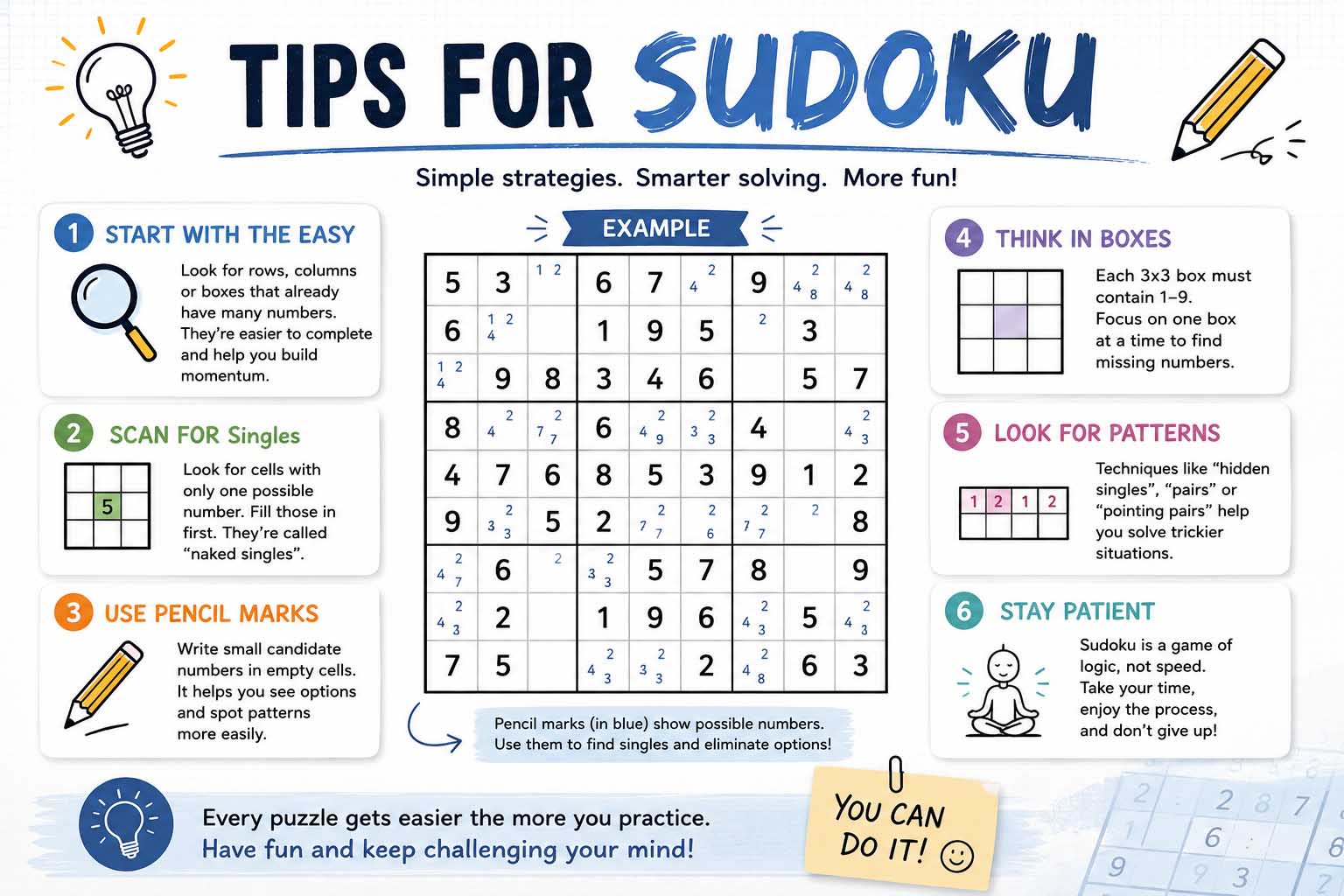
Sudoku is one of the world’s most popular logic games, but it can quickly become frustrating if you don’t know the right approach. Whether you’re solving your first puzzle or tackling expert-level grids, these tips for sudoku will help you think more efficiently, avoid common mistakes, and improve your solving speed without relying on guesses.
The best Sudoku players don’t simply fill in numbers randomly. Instead, they use logical strategies that narrow down possibilities until every square has only one correct answer.
Why Sudoku Is More Than a Number Game
Although Sudoku uses numbers from 1 to 9, it isn’t a math game.
Every puzzle follows three simple rules:
- Each column must contain the numbers 1 through 9.
- Each 3×3 box must contain the numbers 1 through 9.
Winning depends entirely on logical thinking rather than calculation.
If you enjoy Sudoku, you may also like exploring other types of puzzles, since many use similar reasoning and pattern-recognition skills.
Tips for Sudoku Beginners
If you’re just starting, don’t worry about advanced solving techniques.
Mastering a few basic habits will dramatically improve your success rate.
1. Scan the Entire Grid First
Before writing anything, examine every row, column, and box.
Look for:
- Rows with many numbers already filled in
- Nearly complete columns
- Boxes missing only one or two numbers
The easiest moves usually appear during this first scan.
2. Start With Obvious Singles
Whenever only one number can fit into a square, place it immediately.
These “naked singles” often unlock several new moves across the board.
Avoid skipping easy placements because they frequently reveal more opportunities.
3. Focus on One Number at a Time
Instead of trying to solve everything simultaneously, choose one digit.
For example:
- Find every possible location for the number 7.
- Then repeat with 3.
- Continue through all digits.
This method reduces mental overload.
Tips for Solving Sudoku Efficiently
Once you’re comfortable with the basics, these strategies make solving much faster.
Use Elimination Constantly
Ask yourself:
“What numbers are already used in this row?”
“What numbers are already used in this column?”
The remaining possibilities become much easier to identify.
Work Back and Forth
Don’t stay in one section.
Instead:
- Solve a few squares.
- Scan the whole board again.
- Return to another area.
Each completed square creates new solving opportunities elsewhere.
Stay Patient
Many players rush difficult puzzles.
Experienced solvers know it’s perfectly normal to pause, scan again, and gradually build momentum.
Pencil Marks Make Hard Puzzles Easier
One of the biggest improvements beginners can make is using candidate notes.
Instead of guessing, write the possible numbers inside empty cells.
As more squares become confirmed, remove impossible candidates.
Eventually, many cells are left with only one valid number.
Most digital Sudoku apps provide automatic note-taking features, while paper puzzles can be solved with small pencil marks.
Tips for Playing Sudoku Without Guessing
Good Sudoku puzzles never require random guessing.
Instead, every placement should follow logical reasoning.
If you’re tempted to guess:
- Stop.
- Recheck nearby rows.
- Review intersecting columns.
- Examine surrounding boxes.
Nearly every dead end comes from overlooking existing information.
Tips for Hard Sudoku
As puzzle difficulty increases, simple scanning becomes less effective.
Fortunately, several advanced techniques help.
Hidden Singles
Sometimes only one cell in a row, column, or box can contain a specific number—even if several candidate numbers appear in that cell.
Finding these hidden singles often unlocks stalled puzzles.
Locked Candidates
If every possible position for a number inside one box lies in the same row or column, that number can be eliminated from matching cells outside the box.
This technique becomes extremely useful in difficult puzzles.
Naked Pairs
If two cells contain exactly the same two candidate numbers, those numbers cannot appear anywhere else within that row, column, or box.
Learning this strategy dramatically improves solving speed.
Tips for Solving Hard Sudoku
Expert puzzles require patience more than speed.
When solving difficult grids:
- Keep candidate notes organized.
- Double-check every elimination.
- Don’t ignore small clues.
- Revisit earlier sections frequently.
- Avoid rushing after long solving streaks.
Many players solve expert puzzles by making dozens of tiny logical deductions rather than one major breakthrough.
Common Mistakes Beginners Make
Even experienced players occasionally fall into these traps.
Guessing Too Early
Guessing often creates larger problems later.
Whenever possible, rely on logic instead.
Forgetting to Update Notes
Candidate notes should change every time a new number is placed.
Old notes quickly become inaccurate.
Focusing on One Area Too Long
If progress stops, move somewhere else.
Fresh sections often reveal new clues.
Ignoring Easy Squares
Some players search for complicated strategies while overlooking obvious placements elsewhere.
Always scan the entire board before assuming the puzzle has become difficult.
A Simple Sudoku Solving Checklist
Use this routine whenever you begin a puzzle.
| Step | Goal |
|---|---|
| Scan rows | Find missing numbers |
| Scan columns | Identify easy placements |
| Check 3×3 boxes | Complete simple groups |
| Add pencil marks | Track possibilities |
| Eliminate candidates | Narrow options |
| Repeat the scan | Unlock new moves |
Following the same process consistently builds faster solving habits.
How to Improve Your Sudoku Skills
Like any puzzle game, improvement comes through practice.
Try these habits:
- Solve one puzzle every day.
- Gradually increase difficulty.
- Review mistakes after finishing.
- Learn one advanced technique at a time.
- Focus on accuracy before speed.
Over time, your brain begins recognizing common patterns automatically.
If you enjoy logic-based challenges, exploring different types of word puzzles can also strengthen pattern recognition and problem-solving skills in new ways.
Digital Sudoku vs Paper Sudoku
Both versions have advantages.
Paper Sudoku
Pros:
- Better concentration
- Easier visualization
- No distractions
- Traditional experience
Digital Sudoku
Pros:
- Automatic error checking
- Candidate note assistance
- Unlimited puzzles
- Difficulty tracking
- Statistics and timers
Choose whichever format keeps you engaged and motivated to practice.
When Should You Use Advanced Techniques?
Many beginners believe they need expert strategies immediately.
Actually:
Easy puzzles rarely require anything beyond scanning and elimination.
Medium puzzles benefit from candidate notes.
Hard and expert puzzles introduce techniques like:
- Hidden Singles
- Naked Pairs
- Locked Candidates
- X-Wing (advanced)
- Swordfish (expert)
Learning them gradually makes the process far less overwhelming.
Building Better Puzzle Habits
Your solving routine matters just as much as your knowledge.
Good habits include:
- Solving in a quiet environment.
- Taking short breaks during difficult puzzles.
- Checking each completed row before moving on.
- Keeping candidate notes neat.
- Reviewing completed puzzles to understand missed opportunities.
These habits reduce errors while improving confidence.
Why Sudoku Is Good for Your Brain
Many players enjoy Sudoku simply because it’s relaxing.
It also encourages:
- Logical reasoning
- Concentration
- Pattern recognition
- Decision-making
- Memory
- Patience
Although Sudoku isn’t a guaranteed way to improve cognitive health, regular puzzle-solving provides enjoyable mental exercise.
Many players also appreciate the broader benefits of doing puzzles, including stress relief and opportunities to practice structured problem-solving in a fun way.
Frequently Asked Questions
What are the best tips for Sudoku beginners?
Start by scanning the entire grid, filling obvious singles, using elimination, and avoiding guesses. Master these basics before learning advanced techniques.
What are the best tips for solving Sudoku?
Use candidate notes, revisit rows and columns frequently, eliminate possibilities carefully, and solve logically rather than relying on trial and error.
Are there tips for playing Sudoku faster?
Yes. Build a consistent solving routine, recognize common patterns, update candidate notes regularly, and practice daily. Speed naturally improves with experience.
What are the best tips for hard Sudoku?
Learn advanced techniques such as Hidden Singles, Locked Candidates, and Naked Pairs. Keep your notes organized and avoid rushing difficult sections.
Is guessing ever necessary?
A properly designed Sudoku puzzle can be solved using logic alone. If you feel forced to guess, you’ve likely missed an available deduction elsewhere on the board.
Keep Practicing and Trust the Process
The best tips for sudoku aren’t secret tricks—they’re consistent habits that experienced players use in every puzzle. Start with careful scanning, rely on elimination instead of guessing, and build confidence with pencil marks before moving on to advanced strategies. As you solve more grids, you’ll recognize patterns faster and make fewer mistakes. With regular practice, even puzzles that once seemed impossible will become enjoyable challenges instead of frustrating roadblocks