
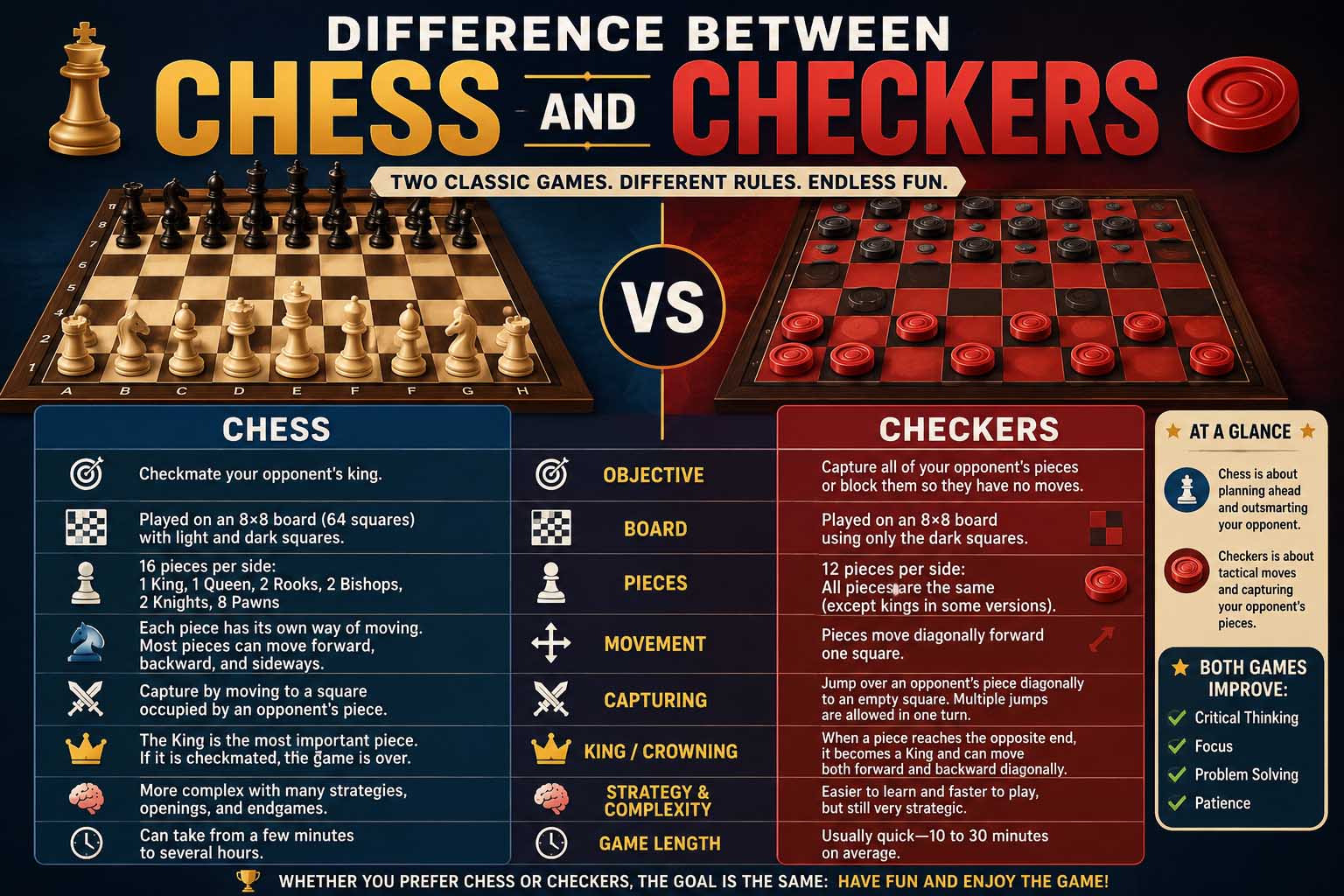
If you’ve ever wondered about the difference between chess and checkers, you’re not alone. Both are classic board games played on an 8×8 board, yet they offer completely different experiences. Chess focuses on unique piece abilities, deep strategy, and long-term planning, while checkers emphasizes movement, captures, and tactical positioning with a simpler ruleset.
Although they may look similar at first glance, learning what is the difference between chess and checkers reveals why each game appeals to different types of players.
Whether you’re deciding which game to learn first or simply curious about how they compare, this guide covers everything you need to know.
Difference Between Chess and Checkers at a Glance
Here’s a quick comparison before we explore the details.
| Feature | Chess | Checkers |
|---|---|---|
| Board Size | 8×8 | 8×8 |
| Number of Pieces | 32 | 24 |
| Piece Types | Six unique types | One basic piece (plus kings) |
| Objective | Checkmate the king | Capture or block all opponent’s pieces |
| Complexity | High | Moderate |
| Average Game Length | 20–60+ minutes | 10–30 minutes |
| Skill Ceiling | Extremely high | High but easier to learn |
Although both games reward practice, chess generally has more complex rules and strategic depth.
What Is Chess?
Chess is one of the world’s oldest and most popular strategy games.
Each player begins with:
- 1 King
- 1 Queen
- 2 Rooks
- 2 Bishops
- 2 Knights
- 8 Pawns
Every piece moves differently, creating countless strategic possibilities.
The goal is simple:
Place your opponent’s king in a position where it cannot escape capture—known as checkmate.
What Is Checkers?
Checkers (also called Draughts in many countries) uses identical pieces for both players.
When a piece reaches the opposite side of the board, it becomes a king and gains the ability to move backward.
The winner is the player who captures every opposing piece or leaves the opponent with no legal moves.
Difference Between Chess and Checkers Rules
The biggest difference between chess and checkers comes from the rules.
Chess Rules
Chess includes:
- Different movement for every piece
- Castling
- En passant
- Pawn promotion
- Check
- Checkmate
- Stalemate
- Draw by repetition
Learning every rule takes time.
Checkers Rules
Checkers focuses on fewer mechanics.
Players mainly learn:
- Diagonal movement
- Forced captures (in many rule sets)
- Multiple jumps
- King promotion
Because there are fewer special rules, beginners usually learn checkers much faster.
Pieces Compared
Chess Pieces
Every chess piece has a unique purpose.
- King protects itself.
- Queen controls large areas.
- Rooks dominate open files.
- Bishops attack diagonally.
- Knights jump over pieces.
- Pawns support the position.
Building an attack requires coordinating several piece types.
Checkers Pieces
Every checker moves the same way until crowned.
Once promoted to king, movement becomes more flexible, but all kings still behave identically.
This creates a much simpler learning curve.
Strategy Differences
Understanding what’s the difference between chess and checkers becomes much easier when looking at strategy.
Chess Strategy
Strong chess players constantly think about:
- Piece development
- King safety
- Center control
- Tactical combinations
- Long-term planning
- Endgames
Even opening moves can influence positions twenty turns later.
Checkers Strategy
Checkers emphasizes:
- Maintaining formation
- Controlling the center
- Creating forced captures
- Timing king promotion
- Avoiding unnecessary exchanges
Planning still matters, but calculations are generally shorter.
Which Game Is Harder?
Most players agree that chess is more difficult to master.
Reasons include:
- More piece types
- More legal moves
- Larger opening theory
- Greater tactical complexity
- Richer endgame knowledge
However, “harder” doesn’t necessarily mean “better.”
Checkers still offers significant strategic depth despite its simpler rules.
Beginner Learning Curve
Chess
Most beginners need several games before remembering how every piece moves.
Improvement also requires learning:
- Openings
- Basic tactics
- Checkmate patterns
- Endgame principles
Progress is rewarding but takes patience.
Checkers
New players often understand the rules within one game.
Afterward, improvement comes from:
- Better positioning
- Smarter exchanges
- Recognizing traps
Because the rules are easier, beginners can focus on strategy much sooner.
Difference Between Checkers and Chess in Competitive Play
Professional chess features:
- Opening preparation
- Deep computer analysis
- Time controls
- International ratings
Professional checkers also has world championships and elite players, although it receives less global attention.
Both games reward experience, pattern recognition, and disciplined thinking.
Which Game Is Better for Kids?
Both games help develop useful skills.
Chess Helps Improve
- Planning
- Patience
- Memory
- Problem-solving
- Visualization
Checkers Helps Improve
- Pattern recognition
- Decision-making
- Tactical thinking
- Focus
- Basic strategic planning
Parents looking for accessible strategy games often begin with checkers before introducing chess.
Many classic tabletop games also belong to broader types of puzzles, encouraging players to develop logic and critical thinking in different ways.
Common Beginner Mistakes
Chess
New players often:
- Move the queen too early.
- Ignore king safety.
- Forget to develop pieces.
- Miss simple tactics.
Checkers
Beginners frequently:
- Give away pieces unnecessarily.
- Ignore forced captures.
- Rush toward promotion.
- Break defensive formations.
Learning from mistakes is part of improving in both games.
Which Game Is Faster?
Checkers usually finishes more quickly.
A casual game often lasts:
- 10–20 minutes
Chess games vary much more.
Some blitz games finish in five minutes.
Classical tournament games may last several hours.
Online Play
Today both games are widely available online.
Popular chess platforms include:
- Chess.com
- Lichess
Online checkers communities are smaller but still active across several gaming websites.
Digital versions make it easy to practice against players from around the world.
Skills That Transfer Between Both Games
Although the rules differ, several skills apply to both.
These include:
- Calculating moves ahead
- Recognizing patterns
- Managing risk
- Controlling space
- Staying patient under pressure
Experience in one game often helps when learning the other.
Similar Board Game Comparisons
Players who enjoy comparing classic tabletop games may also be interested in reading about snooker vs pool, another matchup where similar-looking games follow very different rules and strategies.
Meanwhile, sports fans sometimes ask about the difference between ping pong and table tennis, another example of two closely related games that are often misunderstood.
Strategy enthusiasts who enjoy planning several turns ahead may also appreciate learning how to build a commander deck, since successful deck construction in trading card games also relies on long-term thinking and resource management.
Which Should You Learn First?
Choose chess if you enjoy:
- Deep strategy
- Long-term improvement
- Competitive rankings
- Complex decision-making
Choose checkers if you prefer:
- Faster games
- Simple rules
- Easy setup
- Quick tactical battles
Many players eventually enjoy both.
Frequently Asked Questions
What’s the difference between chess and checkers?
Chess uses six different piece types with unique movement rules, while checkers uses identical pieces that move diagonally and become kings after reaching the opposite side.
What is the difference between chess and checkers for beginners?
Checkers is much easier to learn because it has fewer rules and simpler movement.
Which game requires more strategy?
Chess generally offers greater strategic depth due to its larger number of possible positions and unique pieces.
Is checkers older than chess?
Modern forms of both games have long histories. Variations of checkers trace back thousands of years, while chess evolved from earlier strategy games around the 6th century.
Can playing these games improve critical thinking?
Yes. Both games strengthen planning, concentration, decision-making, and problem-solving, although chess typically requires more complex calculations.
Choosing the Right Game for Your Play Style
The difference between chess and checkers goes far beyond appearance. Chess rewards deep planning, positional understanding, and long-term strategy, making it a favorite among players who enjoy complex decision-making. Checkers, on the other hand, offers a faster pace with straightforward rules while still providing plenty of tactical depth.
If you’re new to board games, checkers is often the easiest place to start. Once you’re comfortable thinking several moves ahead, chess becomes a natural next challenge. Whichever game you choose, consistent practice is the best way to improve, sharpen your strategic thinking, and enjoy one of the world’s most enduring tabletop classics.