
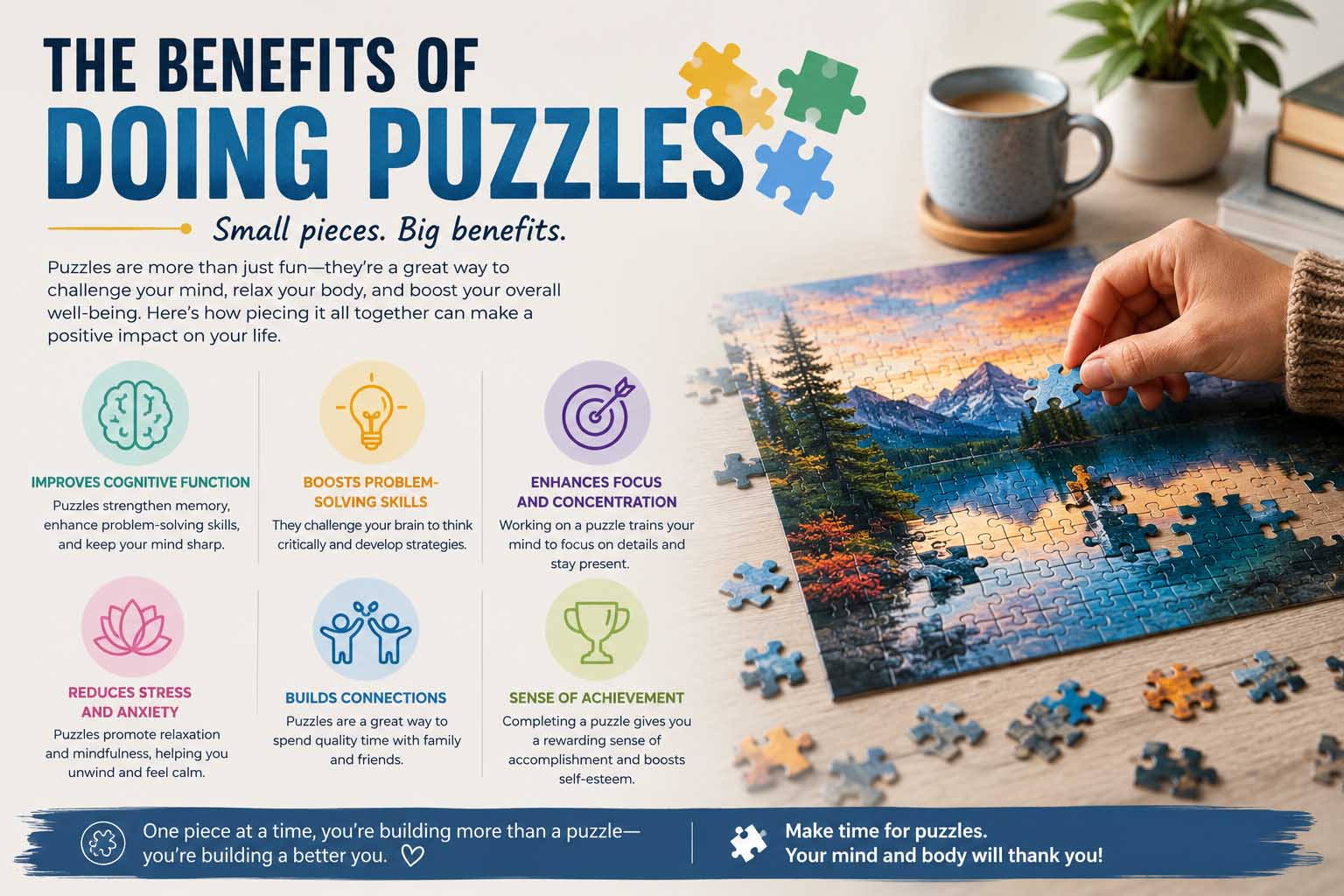
The benefits of doing puzzles go far beyond passing a quiet afternoon. Whether you enjoy jigsaws, crosswords, escape-room challenges, match-three games, or complex logic titles, puzzle play can sharpen useful skills while giving your brain a satisfying break from fast-paced entertainment.
Unlike competitive games that demand quick reactions, puzzles usually reward observation, patience, planning, and experimentation. As a result, they suit casual players, experienced gamers, families, and adults who want a relaxing activity that still feels productive.
Some puzzles take only a few minutes, while others can hold your attention for days. Therefore, the best option depends on whether you want a short mental warm-up, a social challenge, or a longer project that steadily becomes more rewarding.
What Are the Benefits of Doing Puzzles?
Puzzle games challenge the brain without requiring the pressure of ranked matches, difficult boss fights, or constant online competition. Instead, they give players a clear problem and enough freedom to solve it at their own pace.
The main benefits may include:
- Improved concentration
- Better pattern recognition
- Stronger problem-solving habits
- Stress relief
- Greater patience
- A sense of progress
- Social interaction
- Creative thinking
However, no single puzzle provides every benefit equally. For example, a crossword focuses heavily on language, while a jigsaw relies more on shape, color, and spatial awareness.
Because there are many types of puzzles, players can switch formats whenever one activity starts to feel repetitive. That variety also makes puzzle gaming easier to fit into different moods and schedules.
Benefits of Doing Puzzles for Focus and Attention
Most puzzles require sustained attention. Even a simple maze asks you to follow a path, avoid mistakes, and remember where you have already been.
Jigsaws demand similar focus because players must compare colors, edges, shapes, and small visual details. Meanwhile, number puzzles such as Sudoku require careful checking so that one wrong placement does not affect the entire grid.
Puzzles encourage single-tasking
Many people split their attention between games, notifications, videos, and messages. By contrast, a well-designed puzzle encourages you to focus on one goal at a time.
That concentration can feel refreshing, especially after a day filled with interruptions. Since the objective is usually clear, the player can enter a steady rhythm without needing to process constant new information.
Progress creates motivation
Puzzle games often break a large challenge into smaller wins. Finding one missing jigsaw piece, solving one clue, or unlocking one mechanism gives immediate feedback.
As a result, players are more likely to keep going. This gradual progress makes puzzles satisfying without relying heavily on rewards, rankings, or loot systems.
Benefits of Doing Jigsaw Puzzles
The benefits of doing jigsaw puzzles come from the combination of visual analysis, memory, organization, and persistence. Although the rules are simple, completing a large image can require a surprising amount of strategy.
They build visual-spatial skills
Players must judge how small pieces relate to a larger picture. Therefore, jigsaws encourage you to notice shape, orientation, color transitions, and visual patterns.
These skills also appear in many video games. Map reading, inventory arrangement, environmental puzzles, and object placement all rely on similar forms of spatial reasoning.
They teach practical organization
Experienced jigsaw players rarely begin by testing random pieces. Instead, they sort edges, group similar colors, identify key landmarks, and complete smaller sections first.
That approach reflects a useful gaming habit: break a difficult task into manageable parts. The same mindset works in strategy games, crafting systems, dungeon planning, and complicated quest chains.
They provide low-pressure downtime
Jigsaws do not usually include timers or failure screens. Because of that, players can pause whenever they like and return later without losing progress.
For adults who want a calmer alternative to scrolling or watching television, a jigsaw can offer a more active form of relaxation.
Benefits of Doing Crossword Puzzles
The benefits of doing crossword puzzles are closely connected to language, memory, and flexible thinking. Each clue asks the player to search for meaning, consider word length, and use letters from nearby answers.
Crosswords strengthen word recall
A clue may look obvious at first, yet the expected answer can depend on wordplay, abbreviations, or alternative meanings. Consequently, crossword players learn to reconsider their first assumption.
That mental flexibility also helps in adventure games, mystery titles, and RPG dialogue puzzles where wording matters.
They reward general knowledge
Crosswords often include clues about history, entertainment, geography, science, and everyday vocabulary. Therefore, regular play can expose you to unfamiliar words and topics.
Players who prefer language-based challenges may also enjoy exploring different types of word puzzles, including anagrams, word searches, cryptograms, and letter grids.
They are easy to fit into a routine
A large jigsaw needs physical space, whereas a crossword can be played in a newspaper, book, browser, or mobile app. That convenience makes it useful during commutes, breaks, or quiet evenings.
How Puzzles Improve Problem-Solving Skills
Every puzzle places a barrier between the player and the solution. To move forward, you must inspect the available information, test possibilities, and adjust your approach.
This process closely matches the basic loop found in many games:
- Observe the challenge.
- Identify the rules.
- Try a possible solution.
- Review the result.
- Change the strategy if needed.
Because failure is usually safe, puzzles create a useful space for experimentation. A wrong move does not mean the session is wasted. Instead, it provides information about what does not work.
Logic becomes more structured
Logic puzzles often require players to eliminate impossible choices rather than guess immediately. As a result, they encourage methodical thinking.
For instance, if three characters each own a different item, every clue narrows the available combinations. That style of reasoning appears in detective games, tactical planning, and resource management.
Pattern recognition becomes faster
Many puzzle games rely on repeated shapes, symbols, sequences, or movement rules. Over time, players start noticing familiar structures more quickly.
This does not mean every new puzzle becomes easy. However, experience helps players identify where to begin and which details deserve the most attention.
Puzzles Can Support Relaxation
Although difficult puzzles can become frustrating, the right level of challenge often feels calming. A clear objective gives the mind something specific to work on, which may reduce the urge to jump between unrelated tasks.
Hands-on puzzles can be especially relaxing because they combine physical movement with mental focus. Meanwhile, digital puzzle games are useful when you want a quick session without setting up a board or table.
Still, players should choose difficulty carefully. A puzzle that feels impossible may create tension rather than reduce it. Therefore, starting with an easier mode or using a limited hint can keep the experience enjoyable.
Puzzle games also work well as games to play when bored because they offer more engagement than passive entertainment without demanding a major time commitment.
Social Benefits of Puzzle Games
Puzzles are not always solo activities. Cooperative challenges can improve communication because players must share observations and explain their reasoning.
Cooperative play encourages discussion
In an escape room, one player may spot a number while another understands how it connects to a lock. Similarly, a group jigsaw allows different people to work on separate sections before combining them.
Since each person notices different details, collaboration often produces faster results than one player working alone.
Puzzles suit mixed skill levels
Many competitive games create a clear gap between beginners and experienced players. However, cooperative puzzles can make that gap less noticeable.
A younger player may notice a visual clue that an adult missed, while an experienced word-game fan may solve a difficult clue for the group. Therefore, everyone can contribute without needing identical skills.
Puzzle activities can also be a useful choice when planning things to do at a sleepover, especially when the group wants something interactive that does not require special equipment.
Digital Puzzles Versus Physical Puzzles
Both formats offer clear advantages, although the better choice depends on your habits.
| Feature | Digital Puzzles | Physical Puzzles |
|---|---|---|
| Setup | Usually instant | May require space and sorting |
| Portability | Excellent | Limited for larger sets |
| Hints | Often built in | Usually unavailable |
| Social play | Online or local | Easy around one table |
| Screen time | Requires a device | Screen-free |
| Storage | Minimal | Boxes and pieces need storage |
| Replay value | Often high | Depends on puzzle type |
Digital puzzle games are convenient and often include daily challenges, difficulty settings, and automatic saves. Physical puzzles, on the other hand, provide a hands-on experience and reduce screen use.
Many players enjoy both. For example, a mobile crossword works well during short breaks, while a 1,000-piece jigsaw suits a quiet weekend.
Choosing the Right Puzzle for Your Goal
The best puzzle is not always the hardest one. Instead, choose a format that matches the skill or experience you want.
For relaxation
Try:
- Small jigsaw puzzles
- Word searches
- Tile-matching games
- Simple mazes
- Casual hidden-object games
These options usually offer steady progress without too much pressure.
For a stronger challenge
Try:
- Cryptic crosswords
- Expert Sudoku
- Mechanical puzzles
- Escape-room games
- Complex logic grids
These demand more patience and may require note-taking or multiple attempts.
For social gaming
Try:
- Cooperative escape games
- Mystery puzzle boxes
- Team trivia puzzles
- Large jigsaws
- Puzzle-based party games
Choose an option where everyone can see or discuss the clues.
For short daily sessions
Try:
- Mini crosswords
- Daily word games
- Number grids
- Mobile logic puzzles
- Short chess puzzles
A five- or ten-minute session is enough to build a consistent habit.
Beginner Tips for Getting Better at Puzzles
New players often assume that strong puzzle skills depend on natural talent. In practice, a few simple habits make a noticeable difference.
Start with what you know
Look for obvious clues, edge pieces, repeated symbols, or easy answers. Early progress creates useful information for harder sections.
Sort before solving
When working on a jigsaw, group pieces by color or shape. Likewise, in a logic game, write down confirmed facts before testing uncertain ideas.
Use hints carefully
Hints can prevent frustration, yet using them too quickly removes the satisfaction of discovery. A good rule is to step away briefly before requesting help.
Change your perspective
If you feel stuck, rotate a physical puzzle, reread the clue, or approach the problem from the end. Sometimes the difficulty comes from one incorrect assumption.
Stop before frustration takes over
Puzzles should challenge you, not ruin your mood. Taking a break often makes the answer easier to spot when you return.
Common Myths About Puzzle Games
“Only smart people are good at puzzles”
Puzzle skill improves through practice. Familiarity with a puzzle’s rules often matters more than general intelligence.
“Harder puzzles always provide greater benefits”
Difficulty only helps when the challenge remains manageable. If a puzzle feels completely confusing, an easier version may provide a better learning experience.
“Puzzles are only for children or older adults”
Players of every age can enjoy puzzles. Modern puzzle games cover everything from relaxing mobile titles to complicated narrative mysteries.
“Digital puzzles are less valuable”
A digital puzzle can still require memory, logic, and careful observation. The format changes, but the core challenge may remain just as engaging.
Frequently Asked Questions
How often should you do puzzles?
There is no fixed schedule. Even a few short sessions each week can provide an enjoyable mental challenge. Consistency matters more than playing for long periods.
Are puzzles good for adults?
Yes. The benefits of doing puzzles for adults may include relaxation, focused attention, problem-solving practice, social connection, and a satisfying sense of progress.
Which puzzle is best for beginners?
Word searches, smaller jigsaws, simple Sudoku boards, and casual mobile puzzle games are good starting points. Choose a difficulty that feels challenging but not overwhelming.
Are puzzle games better than action games?
Neither type is automatically better. Action games often train reaction speed and quick decision-making, while puzzles place more emphasis on planning, logic, and pattern recognition.
Can puzzles replace professional medical care?
No. Puzzle games are leisure activities, not treatments. Anyone concerned about memory, concentration, stress, or another health issue should speak with a qualified healthcare professional.
Make Puzzle Play Part of Your Gaming Routine
The biggest benefits of doing puzzles come from choosing challenges you genuinely enjoy. A difficult logic game may appeal to one player, while another prefers the relaxed pace of a jigsaw or daily crossword.
Start with a format that matches your interests, then increase the difficulty as your confidence grows. Most of all, treat puzzle play as entertainment rather than a test. When the challenge feels fair and progress feels rewarding, puzzles can become one of the most satisfying parts of your gaming routine.