
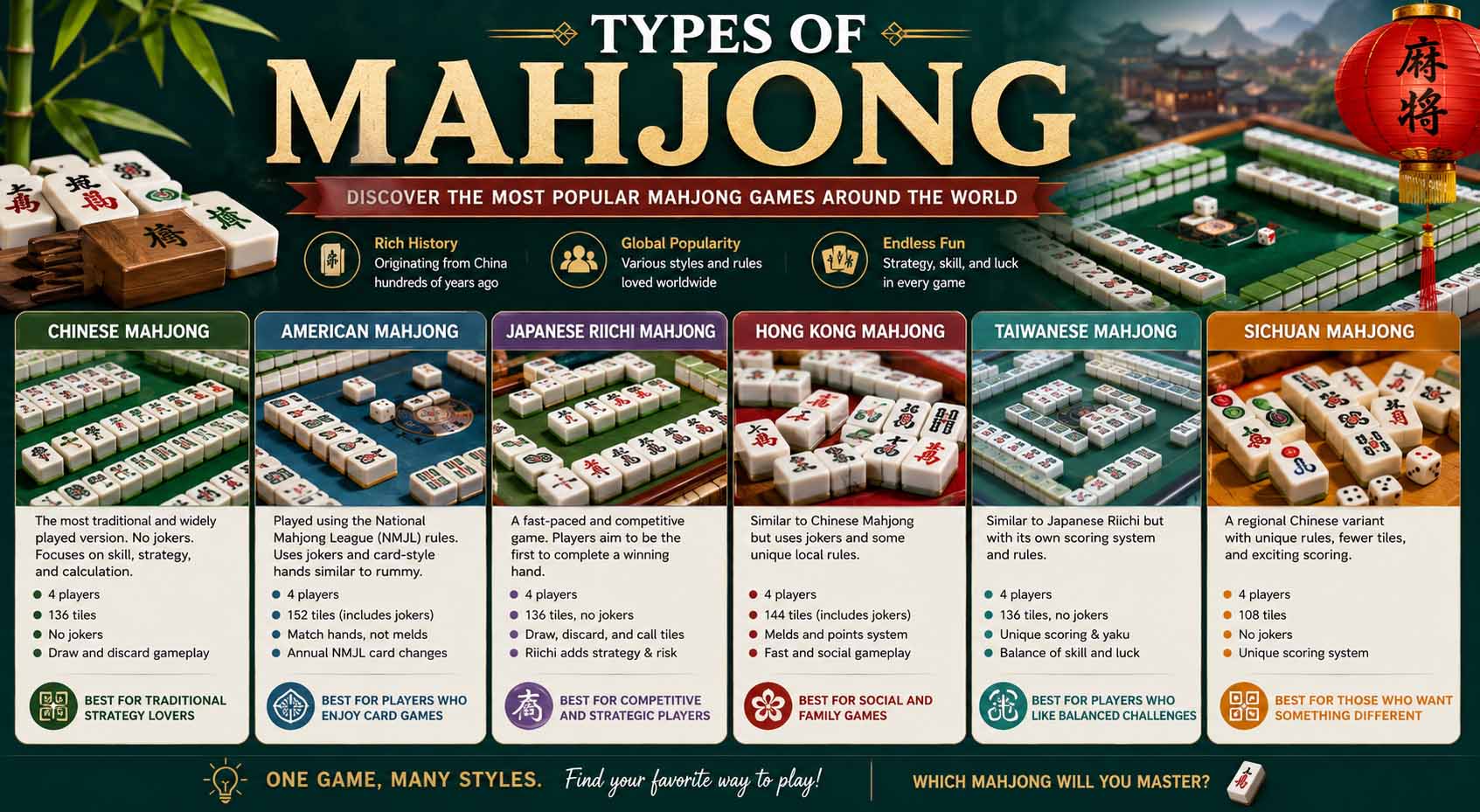
If you’re curious about the types of mahjong, you’re not alone. Mahjong has evolved into dozens of regional versions over the past century. While every variation shares the same basic idea of building winning hands from tiles, the rules, scoring systems, and strategies can be very different.
Whether you’re learning your first game or exploring competitive play, understanding the major Mahjong variants will help you choose the version that matches your interests.
What Is Mahjong?
Mahjong is a tile-based strategy game that originated in China during the 19th century. It is typically played by four players using a set of decorative tiles.
Unlike games that rely mostly on luck, Mahjong rewards:
- Pattern recognition
- Memory
- Probability
- Strategic decision-making
- Risk management
Modern online platforms have introduced millions of new players to the game, making Mahjong more accessible than ever.
Types of Mahjong: The Most Popular Variants
There are many types of mahjong games, but a handful of rule sets dominate both casual and competitive play.
| Mahjong Variant | Players | Difficulty | Popular Regions |
|---|---|---|---|
| Riichi Mahjong | 4 | Medium | Japan |
| Hong Kong Mahjong | 4 | Easy | Hong Kong |
| Chinese Classical | 4 | Medium | China |
| Taiwanese Mahjong | 4 | Medium | Taiwan |
| American Mahjong | 4 | Hard | United States |
| Singapore Mahjong | 4 | Medium | Singapore |
Although the objective remains similar, every version introduces unique rules and scoring methods.
Riichi Mahjong
Riichi Mahjong is one of the most popular modern versions.
It became famous through anime, video games, and online competitive platforms.
Key features include:
- Riichi declaration
- Dora bonus tiles
- Furiten rule
- Closed-hand bonuses
- Detailed scoring system
Riichi rewards careful planning and defensive play, making it popular among experienced strategy gamers.
Hong Kong Mahjong
Hong Kong Mahjong is often recommended for beginners.
Compared to Riichi, it has:
- Simpler scoring
- Faster gameplay
- Easier hand requirements
- Fewer special rules
Many new players start here before moving to more advanced formats.
If you enjoy traditional tabletop games, you might also enjoy learning the hand and foot card game, another classic game built around forming valuable combinations and planning several turns ahead.
Chinese Classical Mahjong
Chinese Classical Mahjong stays closer to the game’s historical roots.
Characteristics include:
- Traditional scoring
- Flower tiles
- Wind bonuses
- Dragon bonuses
- Classic hand values
Many experienced players appreciate its historical authenticity.
American Mahjong
American Mahjong differs significantly from Asian rule sets.
Major differences include:
- Joker tiles
- Annual official hand card
- Fixed winning combinations
- Charleston tile exchange
- Different scoring system
Because of these changes, players familiar with Riichi or Hong Kong Mahjong often need time to adjust.
Taiwanese Mahjong
Taiwanese Mahjong expands gameplay by using 16 tiles per player instead of the standard 13.
This creates:
- Longer rounds
- More possible hand combinations
- Additional strategic decisions
- Higher scoring opportunities
Many players enjoy the increased complexity without reaching the intensity of American Mahjong.
Different Types of Mahjong Games Compared
Choosing among the different types of mahjong games depends on what kind of experience you want.
Best for Beginners
- Hong Kong Mahjong
- Chinese Classical
- Riichi Mahjong
- Taiwanese Mahjong
- Hong Kong Mahjong
- Singapore Mahjong
- Riichi Mahjong
- American Mahjong
Each version emphasizes different skills, so there’s no single “best” variant.
What Are the Different Types of Mahjong Tiles?
One common question is what are the different types of mahjong tiles.
Most traditional sets include these categories:
Suit Tiles
These are the numbered tiles.
- Characters
- Bamboo
- Dots
Each suit contains numbers 1 through 9.
Honor Tiles
Honor tiles include:
- East Wind
- South Wind
- West Wind
- North Wind
Along with:
- Red Dragon
- Green Dragon
- White Dragon
Bonus Tiles
Many rule sets also use:
- Flower tiles
- Season tiles
Some versions ignore bonus tiles completely.
How to Choose the Right Mahjong Version
Before learning complicated scoring systems, think about your goals.
Ask yourself:
- Do I want quick games?
- Am I interested in tournaments?
- Will I mostly play online?
- Do my friends already use one rule set?
For most beginners, Hong Kong Mahjong offers the smoothest learning curve.
Players interested in esports-style competition often move toward Riichi Mahjong because of its thriving online community.
Beginner Tips for Learning Mahjong
Mahjong can feel overwhelming at first.
These tips make learning easier.
Learn Tile Recognition First
Identify every suit before worrying about scoring.
Recognizing tiles quickly speeds up decision-making.
Focus on Basic Winning Hands
Ignore advanced scoring until you consistently complete simple hands.
Watch Experienced Players
Observing games helps you understand strategy much faster than reading rules alone.
Practice Digitally
Several online platforms offer tutorials and beginner-friendly matches.
Advanced Strategy Tips
Once you’ve mastered the basics, strategy becomes increasingly important.
Experienced players focus on:
- Tile efficiency
- Safe discards
- Opponent reading
- Probability tracking
- Hand flexibility
Knowing when to abandon an ambitious hand often separates advanced players from beginners.
Common Mistakes New Players Make
Every Mahjong player makes mistakes while learning.
Watch out for these common errors:
- Keeping too many isolated tiles
- Ignoring defensive play
- Chasing unlikely hands
- Forgetting discarded tiles
- Overvaluing bonus tiles
Developing strong habits early makes improvement much faster.
Mahjong Compared with Other Strategy Games
Mahjong rewards planning, memory, and pattern recognition rather than fast reflexes.
Players who enjoy games involving careful decision-making often appreciate the difference between chess and checkers, since both comparisons highlight how rule complexity changes strategic depth in tabletop gaming.
Like chess, Mahjong becomes deeper the more experience you gain.
Why Mahjong Appeals to Puzzle Fans
Mahjong constantly asks players to recognize patterns while adapting to changing situations.
This explains why many fans also enjoy other types of puzzles, including logic puzzles, Sudoku, and tile-matching games. All of them strengthen observation skills and encourage careful planning.
Mahjong vs. Solitaire Mahjong
Some players confuse traditional Mahjong with digital Mahjong Solitaire.
Here’s the difference.
| Traditional Mahjong | Mahjong Solitaire |
| Multiplayer | Single player |
| Competitive | Puzzle-based |
| Tile combinations | Tile matching |
| Strategic opponents | No opponents |
| Long-term planning | Immediate decisions |
If you’re interested in solo experiences, exploring different types of solitaire can also introduce you to other relaxing puzzle-style games that emphasize planning rather than competition.
Frequently Asked Questions
Which Mahjong version is easiest?
Hong Kong Mahjong is generally considered the easiest version for beginners because of its straightforward scoring and familiar gameplay.
Which Mahjong is played competitively?
Riichi Mahjong has one of the largest organized competitive communities worldwide, particularly in Japan and online.
Do all Mahjong games use the same tiles?
Most versions share the same core tile categories, although some add jokers, flowers, or extra tiles depending on the rules.
Can I learn Mahjong online?
Yes. Many digital platforms include tutorials, AI opponents, and ranked multiplayer modes that help new players improve gradually.
Is Mahjong mostly luck or skill?
Luck influences each round because tile draws are random, but skill plays a major role over time through efficient hand building, defense, and strategic decision-making.
Choosing the Right Mahjong Variant
The best Mahjong version is the one you’ll enjoy learning and playing consistently. If you’re new to the game, start with Hong Kong Mahjong to build confidence. Once you’re comfortable with tile recognition and basic hands, try Riichi or Taiwanese Mahjong for deeper strategy and more rewarding long-term gameplay.
No matter which variant you choose, Mahjong offers a unique blend of tactics, memory, and probability that keeps every match fresh. As your experience grows, you’ll begin to recognize patterns more quickly, make smarter discards, and appreciate the subtle differences that make each Mahjong variant worth exploring.