
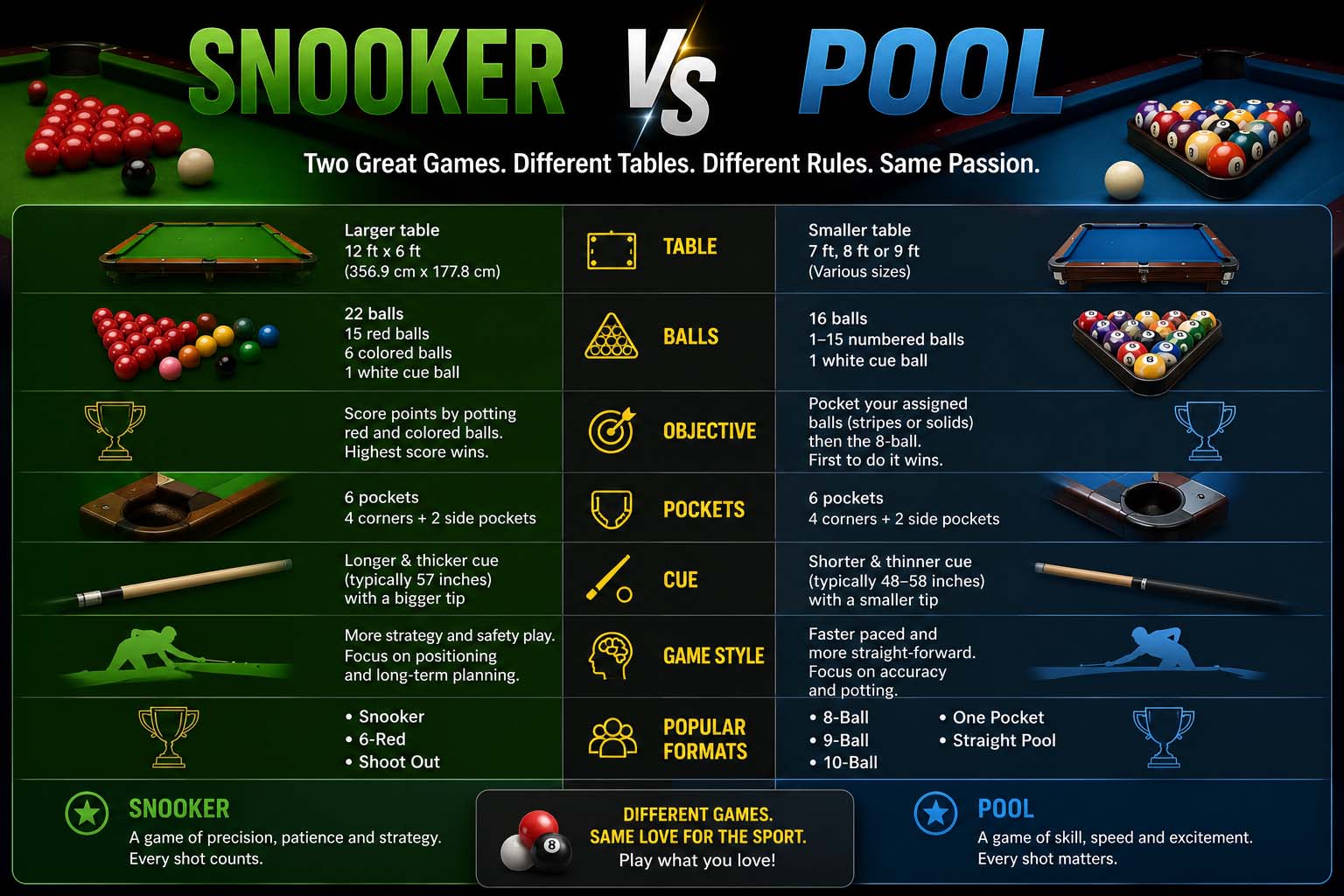
If you’ve ever walked into a billiards hall, you’ve probably wondered about snooker vs pool. At first glance, both games use cues, balls, and tables. Once you start playing, though, the differences become obvious. The tables are different sizes, the rules change, and each game rewards a unique set of skills.
Whether you’re picking up a cue for the first time or looking to improve your game, understanding snooker vs pool will help you choose the version that matches your interests and playing style.
Snooker vs Pool at a Glance
Here’s a quick comparison between the two cue sports.
| Feature | Snooker | Pool |
|---|---|---|
| Table Size | 12 ft | Usually 7–9 ft |
| Number of Balls | 22 | 16 |
| Pocket Size | Smaller | Larger |
| Main Objective | Score points by potting reds and colors | Pocket assigned balls, then the 8-ball or 9-ball depending on the game |
| Difficulty | Higher for beginners | Easier to learn |
| Popular Formats | World Snooker | 8-Ball, 9-Ball, 10-Ball |
Although both games belong to the same family of cue sports, they feel completely different once you begin playing.
What Is Snooker?
Snooker is a precision-based cue sport that originated in the late 19th century.
Players use one white cue ball to pot 15 red balls and six colored balls in a specific order. Every successful shot earns points, and the player with the highest score wins the frame.
Professional tournaments continue to attract millions of viewers worldwide, making snooker one of the most popular cue sports.
Why Snooker Is Challenging
Several factors increase the difficulty:
- Longer shots
- Smaller pockets
- Complex scoring
- Tactical safety play
- Greater emphasis on cue-ball positioning
Even experienced pool players often need time to adjust when switching to snooker.
If you enjoy learning different tabletop games, you may also like reading the shut the box rules, another classic game that rewards planning and smart decision-making.
What Is Pool?
Pool is the cue sport most people encounter in bars, clubs, recreation centers, and gaming lounges.
Instead of focusing on point scoring, most pool variants require players to pocket specific groups of balls before sinking the winning ball.
Popular versions include:
- 8-Ball
- 9-Ball
- 10-Ball
- Straight Pool
Pool tables are smaller than snooker tables, making games faster and easier for beginners to enjoy.
Why Pool Is Popular
Many new players start with pool because:
- The rules are easier to understand.
- Games finish more quickly.
- Equipment is widely available.
- Most recreation centers have pool tables.
That accessibility makes pool one of the easiest cue sports to learn with friends.
Snooker vs Pool: The Biggest Differences
Although they look similar, the gameplay varies in several important ways.
Table Size
The most noticeable difference is the table.
A standard snooker table vs pool table comparison shows that snooker tables measure 12 feet in length, while pool tables usually range from 7 to 9 feet.
The extra distance in snooker demands more precise shot-making and cue-ball control.
Balls
Snooker uses:
- 15 red balls
- 6 colored balls
- 1 cue ball
Pool generally uses:
- 15 numbered object balls
- 1 cue ball
Because of the different ball layouts, strategies also change considerably.
Pockets
Snooker pockets are narrower.
Pool pockets are wider and more forgiving.
As a result, shots that feel comfortable on a pool table may become surprisingly difficult on a snooker table.
Scoring System
Pool games usually end after players pocket all assigned balls and finish with the winning ball.
Snooker uses a point-based scoring system.
Players alternate between red and colored balls while building breaks that can reach well over 100 points during professional matches.
Equipment Comparison
Besides the table, players also notice differences in equipment.
Snooker Equipment
Typical equipment includes:
- Snooker cue
- Rest or bridge
- Chalk
- 22 balls
- Large snooker table
Pool Equipment
Pool players commonly use:
- Pool cue
- Cue ball
- 15 object balls
- Smaller table
- Mechanical bridge when needed
While both sports share many accessories, cues often differ slightly in tip size and design.
Which Game Is Better for Beginners?
For most new players, pool is easier to learn.
The smaller table allows beginners to make successful shots more often, which helps build confidence.
Snooker, by comparison, rewards patience and consistent practice.
Many players begin with pool before trying snooker later.
If your game nights include more than cue sports, learning how to play bunco is another fun way to enjoy a relaxed, social competition with friends and family.
Basic Skills That Help in Both Games
No matter which cue sport you choose, several fundamentals improve your performance.
Develop a Consistent Stance
Keep your body balanced and your bridge hand steady.
A consistent stance improves accuracy over time.
Focus on Cue-Ball Control
Strong players think beyond the current shot.
Positioning the cue ball correctly makes the next shot much easier.
Practice Straight Shots
Straight shots teach alignment and stroke consistency.
Once these become comfortable, more advanced angles feel much less intimidating.
Learn Safety Play
Not every turn should focus on attacking.
Sometimes the best decision is leaving your opponent with no easy shot.
Defensive thinking becomes especially valuable as your skill level increases.
Pool vs Snooker: Which Style Fits You?
When comparing pool vs snooker, the best choice depends on what you enjoy.
If you like quick games, casual competition, and easier access to tables, pool is an excellent option.
If you enjoy long tactical battles, careful planning, and precise shot-making, snooker offers a rewarding challenge that keeps experienced players improving for years.
Pool vs Snooker vs Billiards
Many people use these names interchangeably, but they describe different cue sports.
| Game | Table | Balls | Main Goal |
|---|---|---|---|
| Pool | 7–9 ft | 16 | Pocket your group of balls and finish with the winning ball |
| Snooker | 12 ft | 22 | Score points by potting reds and colored balls in sequence |
| Billiards | Pocketless table | 3 | Score points through carom shots rather than pocketing balls |
When comparing pool vs snooker vs billiards, the biggest differences are the table design, the number of balls, and the scoring system. Billiards focuses on precise cue-ball control without pockets, while pool and snooker revolve around potting balls.
Players searching for snooker vs pool vs billiards should remember that all three games develop similar cue skills, but each rewards different strategies.
Advanced Strategies for Better Results
Once you’ve mastered the basics, improving your decision-making becomes just as important as making difficult shots.
Think Two or Three Shots Ahead
Experienced players rarely focus on a single shot.
Instead, they consider where the cue ball will finish and how that position creates the next opportunity. Good cue-ball control often separates intermediate players from advanced competitors.
Control Your Speed
Power is rarely the answer.
A smooth, controlled stroke usually delivers better accuracy and makes cue-ball positioning much easier. Learning to vary shot speed is especially valuable in snooker, where table length increases the challenge.
Use Safety Shots Wisely
Aggressive play can be exciting, but smart defense wins plenty of matches.
Leaving your opponent without a clear shot forces mistakes and creates better scoring opportunities on your next visit to the table.
Common Mistakes Beginners Make
Almost every new player develops a few habits that slow improvement.
Some of the most common include:
- Hitting every shot too hard.
- Standing up before completing the stroke.
- Ignoring cue-ball positioning.
- Looking only at the object ball instead of the contact point.
- Choosing difficult shots instead of safer options.
Correcting these habits early helps players improve much faster.
Choosing Between Snooker and Pool
Both games offer unique experiences, so the right choice depends on your goals.
Choose pool if you:
- Want quicker games.
- Play casually with friends.
- Have access to a local pool table.
- Prefer learning the basics quickly.
Choose snooker if you:
- Enjoy tactical gameplay.
- Like long-term skill development.
- Appreciate precision and patience.
- Want to challenge yourself with professional-style competition.
Many cue sports enthusiasts eventually learn both because the skills complement each other.
Practicing Outside the Pool Hall
You don’t always need a cue to sharpen your competitive thinking.
Strategy games, card games, and tabletop games can improve planning, decision-making, and pattern recognition. For example, a hand and foot card game encourages players to think several moves ahead, which is also valuable when planning position play on the table.
Likewise, games built around probability and timing—such as game of spades—reward careful judgment rather than rushed decisions, making them a fun way to exercise strategic thinking.
If you’re looking for more ideas when you can’t get to the pool hall, exploring different games to play when bored can help keep your mind active while still enjoying competitive gameplay.
Is Snooker Harder Than Pool?
For most players, yes.
Snooker generally has:
- Larger tables.
- Smaller pockets.
- Longer average shots.
- More complex scoring.
- Greater emphasis on tactical play.
That doesn’t mean pool is easy.
Professional pool players demonstrate remarkable precision, consistency, and cue-ball control. The skills simply develop in different ways.
Tips for Improving Faster
If your goal is steady progress, build a simple practice routine.
Try to:
- Spend time on straight shots before attempting trick shots.
- Practice cue-ball positioning instead of only potting balls.
- Watch professional matches to study shot selection.
- Play against stronger opponents whenever possible.
- Stay patient after missed shots and focus on the next opportunity.
Even 20 to 30 minutes of focused practice several times a week can lead to noticeable improvement.
Frequently Asked Questions
What is the biggest difference between snooker vs pool?
The largest differences are the table size, number of balls, pocket dimensions, and scoring system. Snooker emphasizes point scoring, while pool usually focuses on clearing your assigned balls.
Is snooker more difficult than pool?
Most beginners find snooker more challenging because of the larger table and tighter pockets.
Can pool skills transfer to snooker?
Yes. Fundamentals such as stance, stroke, aiming, and cue-ball control apply to both games, although snooker requires greater precision.
Is billiards the same as pool?
No. Traditional billiards is played on a table without pockets and follows different rules from both pool and snooker.
Which cue sport should beginners learn first?
Pool is usually the easier starting point because the rules are simpler and tables are more widely available.
Final Takeaways
Understanding snooker vs pool makes it much easier to choose the cue sport that matches your interests.
Pool is an excellent choice for beginners thanks to its accessible rules, smaller tables, and faster matches. Snooker rewards patience, precision, and long-term skill development, making it a favorite among players who enjoy tactical competition.
Whichever game you choose, focus on building strong fundamentals before chasing advanced shots. Consistent practice, smart cue-ball control, and good decision-making will improve your results far more than relying on power alone. As your confidence grows, you’ll find that every frame offers new opportunities to refine your strategy and enjoy one of the world’s most rewarding cue sports.