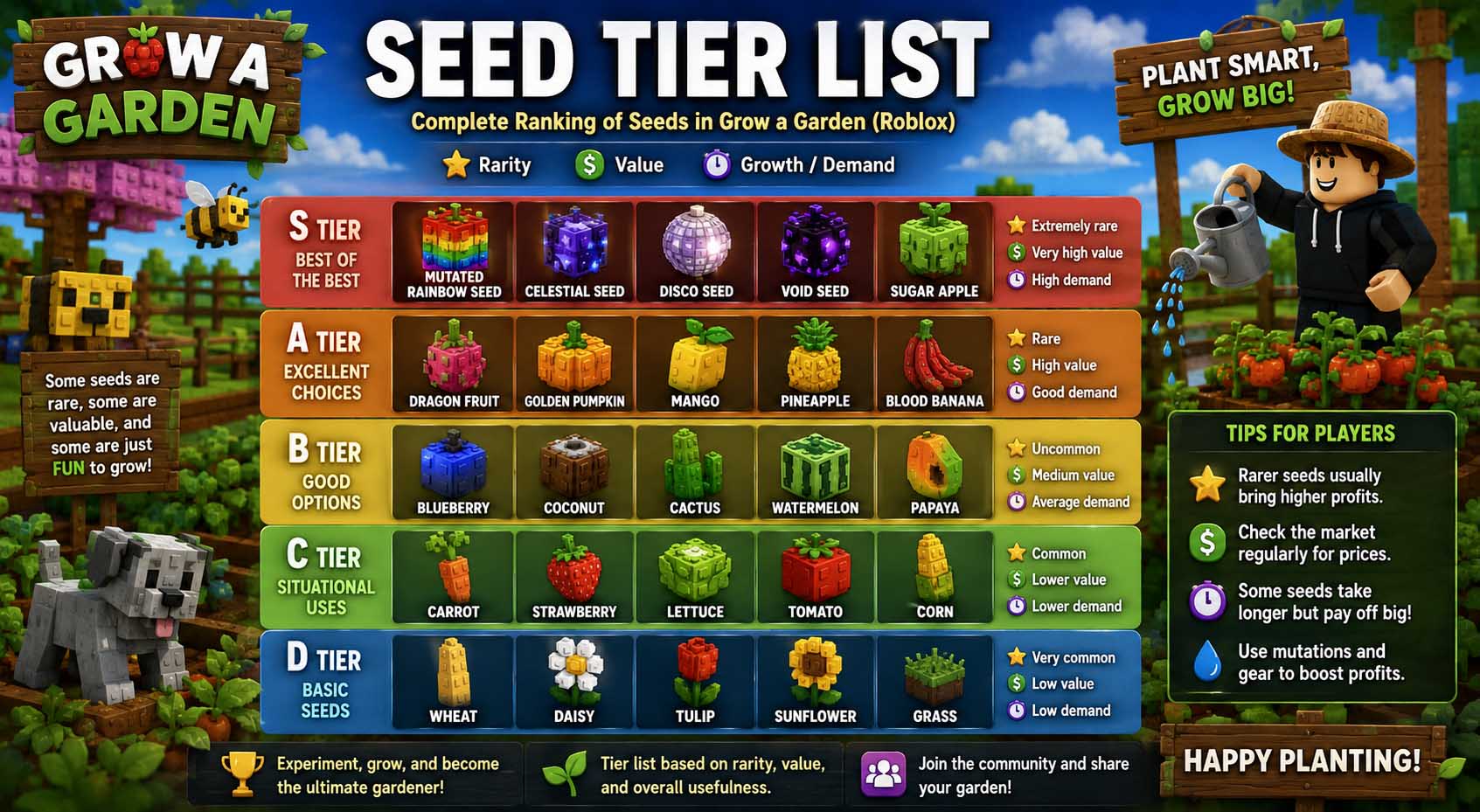
Choosing what to plant becomes surprisingly complicated once your garden starts filling up. This Grow a Garden seed tier list ranks seeds and crops by their practical usefulness, earning potential, repeat-harvest value, and how worthwhile they are for your limited garden space. Since Grow a Garden on Roblox keeps receiving new crops and event content, a good ranking should help you make decisions rather than simply tell you which plant has the biggest number attached to it.
For 2026, that distinction matters even more. Hundreds of crops have appeared across permanent shops, events, packs, crafting systems, and limited updates, while availability can change over time.
So, instead of treating every rare seed as automatically better, this guide focuses on what players actually need: which seeds deserve priority, which are useful while progressing, and which can usually be replaced once stronger options become available.
Grow a Garden Seed Tier List 2026
The following Grow a Garden seed tier list 2026 is best used as a progression guide rather than a permanent mathematical ranking. Updates can introduce stronger crops, while mutations and limited availability can change what makes sense for your particular garden.
| Tier | Seeds and crop examples | Best use |
|---|---|---|
| S Tier | Sugar Apple, Giant Pinecone, Burning Bud, Ember Lily, Bone Blossom and other top limited crops | Late-game profit and premium plots |
| A Tier | Beanstalk, Pepper, Cacao, strong event crops | Reliable progression and repeat harvesting |
| B Tier | Bamboo, Mango and other useful mid-game crops | Building capital |
| C Tier | Tomato, Corn and similar progression crops | Early-game farming |
| D Tier | Carrot, Strawberry, Blueberry and other basic starters | First purchases and temporary plots |
This ranking is intentionally broad. For example, current crop databases list shop plants such as Sugar Apple, Burning Bud, Giant Pinecone, Elder Strawberry and Romanesco alongside a much larger pool of limited and event plants.
Meanwhile, older event crops can remain extremely desirable even when a new player cannot obtain them normally. Therefore, availability should always be considered before comparing two seeds.
Your grow a garden value strategy also matters here. A seed with a high-value crop may look amazing on paper, yet a reusable plant that keeps producing can sometimes be more useful across a long play session.
How This Grow a Garden Roblox Seed Tier List Works
A useful Grow a Garden Roblox seed tier list cannot rely on rarity alone. Instead, several factors determine whether a seed deserves valuable plot space.
Crop value
First, consider what the harvested crop can produce economically. Higher base value creates a stronger starting point, especially when other value multipliers enter the picture.
However, raw value is only one part of the calculation. A crop that looks weaker initially may become far more attractive when it produces repeatedly.
Single harvest vs multi-harvest
Next, check whether you must replant after harvesting.
Single-harvest plants can still be useful, especially during early progression. However, repeat-producing crops reduce the amount of buying and planting you need to do. As a result, they are often more convenient for established gardens.
Current seed databases, for instance, list several expensive shop crops—including Giant Pinecone, Burning Bud, Sugar Apple and Ember Lily—as multi-harvest plants.
Mutation potential
Mutations can completely change the economics of a crop. In fact, a lower-ranked plant with valuable mutations can outperform an unmodified crop that normally sits higher on a tier list.
Therefore, advanced players should judge seeds by both their normal performance and their potential within a mutation-focused setup.
If you are building around that mechanic, understanding pet mutations grow a garden strategies can also help because pets and crop systems can influence how you approach long-term optimization.
S-Tier Seeds: Your Highest-Priority Crops
S-tier should contain plants that justify keeping valuable garden space occupied for long periods.
Sugar Apple remains a strong example among regular shop crops. Current databases list it as a multi-harvest Prismatic crop, while other high-end shop options include Burning Bud, Giant Pinecone, Elder Strawberry and Romanesco.
Bone Blossom is another notable name when discussing the broader pool of powerful crops. However, limited or event-related plants need a different evaluation from ordinary Seed Shop purchases because a new player may not have direct access to them.
That creates a simple rule:
Do not remove a powerful limited crop simply because a newer shop seed exists.
Instead, compare what each plant actually does for your garden.
S-tier plants work particularly well for players who already have enough money to stop worrying about cheap starter crops. At that point, garden space becomes the scarce resource.
A-Tier Seeds: Strong Choices Without Needing the Absolute Best
A-tier crops are where many gardens can make consistent progress.
Beanstalk, Pepper, and Cacao are good examples of established shop crops that can remain useful while you work toward more expensive options. Their exact position can shift as the game changes, yet they represent the type of seed that bridges the gap between beginner farming and premium late-game planting.
For many players, that makes A-tier more useful than S-tier at first.
After all, knowing the strongest seed in the game does not help much when you cannot afford it or obtain it.
Certain event plant categories can also create specialized strategies. For example, players interested in tranquil plants grow a garden content may want to judge those crops within the mechanics and availability of their associated content rather than comparing them blindly with basic Seed Shop plants.
Therefore, keep strong event plants when they serve a clear purpose.
B-Tier Seeds: The Progression Workhorses
B-tier is not a bad tier.
Instead, it contains crops that make sense while you are building toward something better. These plants can provide enough income to move your account forward without demanding the huge investment associated with late-game seeds.
This tier is especially useful for newer players who are tempted to spend everything immediately.
Rather than buying one expensive seed and leaving the rest of your garden weak, you may progress faster by filling several plots with affordable productive plants.
Meanwhile, some plant categories have uses beyond a simple global ranking. Prickly plants grow a garden, for example, can become relevant when quests, events, or collection goals ask for specific crop types.
So, never sell or remove something solely because a general tier list labels it B-tier.
C and D Tier: Starter Seeds Still Have a Purpose
Carrot, Strawberry, Blueberry, Tomato, and other inexpensive seeds sit toward the bottom once your account becomes established.
Yet that does not make them useless.
Carrot is particularly straightforward for a new player because it lets you learn the basic plant-harvest-sell loop without risking much currency. Then, as your balance grows, you can replace basic crops with stronger options.
Tomato can serve as another transitional crop before expensive seeds become realistic.
Therefore, D-tier means low priority for developed gardens, not “never plant this.”
Starter seeds exist to get your economy moving. Once they have done that job, replacing them is normal progression.
Best Seed Strategy for Beginners
If you have just started playing, do not chase the rarest seed immediately.
Instead, use a simple progression loop:
- Plant affordable seeds across available space.
- Harvest and sell consistently.
- Reinvest rather than spending everything elsewhere.
- Move toward reliable multi-harvest plants.
- Save premium garden space for stronger crops.
- Keep useful limited plants when replacing ordinary crops.
- Start optimizing mutations once your basic income feels comfortable.
The Seed Shop remains a central source of seeds, while event vendors, seed packets and other systems can provide plants outside the standard shop rotation.
Because of that, beginners should avoid assuming that every crop they see in another player’s garden is immediately obtainable.
Advanced Garden Strategy: Stop Ranking Seeds in Isolation
Experienced players should look beyond a simple seed tier list Grow a Garden chart.
Your whole garden matters.
For instance, pets can complement farming strategies in ways that raw seed rankings cannot capture. Therefore, comparing the best pets in grow a garden can help when you are trying to optimize a developed account rather than simply deciding what to buy next.
Likewise, mutations can dramatically raise crop value. That means an advanced player may intentionally keep a lower-base-value plant when it works particularly well with their current strategy.
Garden space should also influence every decision.
Ask yourself:
If I remove this plant, can I replace it with something that earns more or offers better long-term utility?
If the answer is yes, upgrading makes sense. If the answer is no, keeping the existing crop may be smarter than chasing tier labels.
Permanent Seeds vs Limited and Event Crops
This distinction causes plenty of confusion in a Grow a Garden Roblox seed tier list 2026.
A permanent shop crop and an old event crop are not competing under identical conditions.
Current databases separate ordinary obtainable plants from hundreds of limited plants, showing just how much the crop pool has expanded.
As a result, a complete historical ranking can be interesting but less useful to a new player. If the top ten seeds are all unavailable, the list does not answer the question that matters: What should I plant today?
A better approach is to maintain two mental rankings.
First, rank the crops you currently own.
Then, rank the crops you can realistically obtain.
That keeps your decisions practical.
Common Seed Tier List Mistakes
One common mistake is assuming that expensive automatically means best. Price can indicate progression, but repeat harvests, crop value, mutations, availability, and garden space all affect the real result.
Another mistake is destroying limited plants too quickly. Before removing an old event crop, check whether you can replace it later.
Players also sometimes ignore the wider garden setup. A strong crop becomes more useful when the rest of your strategy supports it.
Finally, avoid treating a tier list as permanent. Grow a Garden has accumulated hundreds of crops, including many limited ones, so new updates can easily shift the relative value of older choices.
Grow a Garden Seed Tier List FAQs
What is the best seed in Grow a Garden?
There is no single answer that stays correct across every update and account. High-end crops such as Sugar Apple, Giant Pinecone, Burning Bud and powerful limited plants can all deserve premium garden space, depending on availability and your strategy.
Are rare seeds always better?
No. Rarity is useful information, but it should not replace practical evaluation. Consider crop value, repeat harvesting, mutation opportunities and whether you can realistically obtain the seed.
Should I remove all low-tier crops?
Not immediately. Early-game crops help generate the currency needed for upgrades. Therefore, replace them gradually as stronger plants become affordable.
Are mutations more important than the seed?
Both matter. However, mutations can increase the value of a crop enough to change how it performs compared with its normal tier.
Should I keep old event crops?
Usually, check their availability before removing them. Since many crops are limited, deleting something difficult or impossible to reacquire can be a costly mistake.
Build Your Garden Around Value, Not Just Rarity
The best Grow a Garden seed tier list is a decision tool, not a rulebook. S-tier crops deserve attention, yet affordable progression plants still have a job, while limited crops and mutations can change the value of almost any garden setup.
Start by replacing weak starter plants when you can comfortably afford stronger options. Then, prioritize repeat-harvest crops, protect valuable limited plants, and optimize your available space as your account grows.
Most of all, recheck rankings after major updates. Grow a Garden’s crop pool changes often enough that yesterday’s perfect garden may have a better upgrade path tomorrow.