
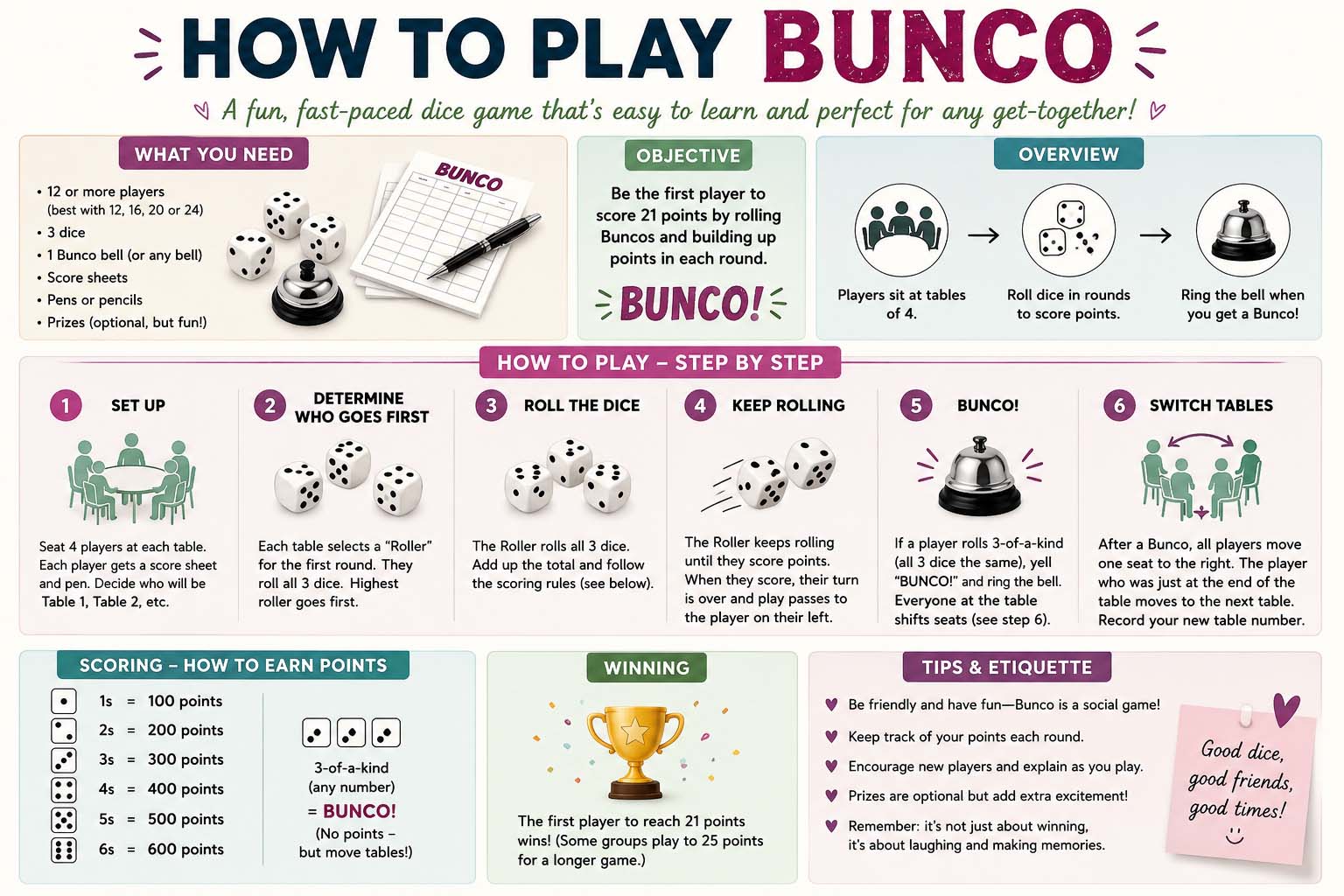
Learning how to play Bunco is simple, even if you have never joined a dice game before. Bunco is a lively social game that combines luck, teamwork, and friendly competition. Players roll three dice, earn points, and move between tables while enjoying time with friends and family.
Unlike complicated board games, Bunco requires very little strategy. Instead, players focus on rolling the correct numbers during each round. As a result, beginners can understand the basic rules within minutes.
A traditional Bunco game includes 12 players at three tables. Each table has four participants who form two teams. However, smaller groups can also enjoy the game with a few adjustments.
The game follows six numbered rounds per set. During each round, players try to roll the number that matches the current round. For example, players score points for rolling threes during round three.
Although Bunco relies mainly on luck, its quick turns and changing partnerships create an entertaining experience. Therefore, it remains a popular choice for parties, family gatherings, and organized game nights.
This guide explains the equipment, scoring system, table rotations, and basic instructions you need to enjoy your first game.
How to Play Bunco: Basic Rules
Bunco is a multiplayer dice game in which players earn points by rolling specific numbers.
Each round focuses on one number from one through six. Players use three standard six-sided dice and continue rolling while they earn points.
For example, during round two, every die showing a two earns one point.
However, special combinations can earn larger bonuses.
The main objective is to win rounds, collect Buncos, and enjoy friendly competition. Since the game depends mostly on chance, players do not need advanced skills.
In addition, traditional Bunco encourages social interaction because players regularly change partners and tables.
How to Play Bunco With Different Group Sizes
A traditional game uses 12 participants.
Organizers divide the players into three groups of four:
- Head table: Four players
- Middle table: Four players
- Low table: Four players
At each table, two teams compete against each other.
However, groups with fewer participants can adapt the format. For example, eight players can use two tables, while four players can enjoy a single-table version.
The essential scoring rules remain similar, although smaller groups may simplify table rotations.
Equipment Needed to Play Bunco
Bunco requires only a few basic supplies.
For a traditional 12-player game, prepare:
- Nine standard six-sided dice
- Three tables
- Twelve chairs
- Individual Bunco scorecards
- Pencils or pens
- One table score sheet per table
- A bell or another starting signal
- An optional traveling prize or marker
Each table needs three dice.
Additionally, the head table usually controls the beginning and ending of each round.
For more information about game traditions, the World Bunco Association provides a resource for Bunco players.
How to Play Bunco Dice Game: Rules and Rounds
The basic rules become easier once you understand how numbered rounds work.
Each round has a target number that matches its position in the set.
For example, round one focuses on ones, while round six focuses on sixes.
How to Play Bunco Through Six Rounds
A typical Bunco set follows this sequence:
| Round | Target Number | Scoring Example |
|---|---|---|
| Round 1 | 1 | Each rolled 1 earns one point |
| Round 2 | 2 | Each rolled 2 earns one point |
| Round 3 | 3 | Each rolled 3 earns one point |
| Round 4 | 4 | Each rolled 4 earns one point |
| Round 5 | 5 | Each rolled 5 earns one point |
| Round 6 | 6 | Each rolled 6 earns one point |
After round six, organizers can begin another set at round one.
Many Bunco groups play several sets during a complete game night. However, the exact number depends on the available time and house rules.
How to Take Turns When Playing Bunco
The first player rolls all three dice.
If at least one die matches the round number, the player earns points and rolls again.
However, if the roll produces no scoring combination, the player’s turn ends.
The next player then takes the dice and begins rolling.
This process continues until the head table signals the end of the round.
When Does a Bunco Round End?
In a common Bunco format, the head table rings a bell when one team reaches at least 21 points.
However, the other tables do not need to reach 21 points.
Instead, everyone stops when the head table signals that the round has ended.
Groups may allow a player to finish a scoring sequence already in progress. Therefore, organizers should explain that house rule before starting.
How to Play Bunco: Dice Scoring Rules
Understanding the scoring system is the most important part of learning the game.
Fortunately, most combinations are easy to recognize.
How to Score One Matching Die in Bunco
During any round, each die showing the target number earns one point.
For example, imagine you are playing round four.
You roll:
4 – 2 – 6
Since one die shows a four, you earn one point.
You can then roll again.
Bunco Scoring With Two Matching Dice
If two dice match the current round number, you earn two points.
For example, during round three, you roll:
3 – 3 – 5
You earn two points because two dice show the target number.
Additionally, you continue rolling because the roll produced points.
What Is a Bunco in the Dice Game?
A Bunco occurs when all three dice show the current round number.
For example, during round five, you roll:
5 – 5 – 5
This combination earns 21 points under common Bunco rules.
In addition, the player usually records one personal Bunco on their individual scorecard.
Players often celebrate by shouting “Bunco!” when this happens.
What Happens When All Three Dice Match Another Number?
Rolling three identical numbers that do not match the current round number also earns a bonus in many versions.
For example, during round two, you roll:
6 – 6 – 6
Many groups award five points for this combination.
Players sometimes call this a mini Bunco or baby Bunco.
However, the name and scoring value can vary between groups.
Therefore, confirm the bonus rules before the first round.
Bunco Dice Scoring Chart
| Dice Combination | Typical Points |
|---|---|
| One die matches the round number | 1 |
| Two dice match the round number | 2 |
| Three dice match the round number | 21 |
| Three identical dice that do not match the round | 5 |
| No scoring combination | 0 |
These values represent a common scoring system. However, some Bunco groups use slightly different house rules.
How to Play Bunco Step by Step
Follow these instructions to organize a traditional game for 12 players.
Step 1: Set Up Tables to Play Bunco
First, arrange three tables with four chairs each.
Designate one as the head table, another as the middle table, and the third as the low table.
Then, place three dice and a table score sheet at each location.
The head table should also have a bell or another clear signaling device.
Step 2: Divide Players Into Teams
Next, seat four players at each table.
Teammates sit across from one another, while opponents sit beside them.
Each team combines the points its members earn during the round.
However, players should also keep individual records of their Buncos and round results.
Step 3: Start Playing Bunco
The head table starts round one by ringing the bell.
Players at all three tables begin rolling their dice.
During this round, every die showing a one earns one point.
For example, rolling 1–1–4 earns two points.
The player continues rolling until a roll produces no points.
Step 4: Continue Rolling and Scoring
Players take turns clockwise.
As long as a player earns points, they keep rolling.
However, a non-scoring roll ends the turn.
The next player then rolls all three dice.
Meanwhile, the scorekeeper tracks each team’s total.
Step 5: End the Round
When a team at the head table reaches at least 21 points, the head table signals the end of the round.
All tables then determine which team earned the higher score.
Players record a win or loss according to the group’s scoring rules.
If a table finishes with a tie, organizers can use a predetermined tiebreaker.
Step 6: Rotate Tables During Bunco
After each round, players move according to the group’s rotation rules.
In a common format, the winning teams at the middle and low tables move upward.
Meanwhile, the losing team at the head table moves down to the middle table.
At the low table, the losing team usually remains in place.
Players then switch partners as required by the house rules.
This rotation helps participants interact with different people throughout the game.
Step 7: Play the Remaining Rounds
Next, begin round two and focus on rolling twos.
Continue through rounds three, four, five, and six.
After completing all six rounds, the group has finished one set.
However, many organized Bunco nights include multiple sets before awarding prizes.
How to Play Bunco for Beginners: Essential Tips
New players often worry about remembering the rules or keeping score correctly.
Fortunately, Bunco becomes familiar after only a few turns.
Remember the Current Bunco Round Number
The simplest beginner tip is to focus on the target number.
For example, if the group is playing round three, look for threes.
You do not need to memorize complicated combinations.
Instead, remember that matching the target number earns points, while three matching target dice create a Bunco.
Keep Your Bunco Scorecard Updated
Each player should record their individual results accurately.
For example, many groups track round wins, losses, and personal Buncos.
However, table scores and individual records serve different purposes.
The table score determines which team wins the current round, while individual records help determine prizes at the end of the event.
Learn the Bunco House Rules Before Starting
Not every Bunco group follows identical rules.
For instance, some groups use different table rotations or bonus-scoring methods.
Therefore, ask the organizer about the scoring system, tiebreakers, and total number of sets.
A short explanation before the game can prevent confusion later.
Enjoy the Social Experience
Bunco depends more on luck than strategic planning.
As a result, beginners can compete comfortably with experienced players.
In addition, changing partners creates opportunities to meet and talk with other participants.
The social atmosphere is often just as important as the final score.
How to Play Bunco With Table Rotations
Table rotation is one of the game’s most distinctive features.
It allows players to meet new teammates and opponents throughout the evening.
Bunco Head Table Rotation Rules
The head table controls the round-ending signal.
After the round, the losing team typically moves to the middle table.
Meanwhile, the winning team stays at the head table.
Players may then rearrange partnerships according to the agreed rules.
Bunco Middle Table Rotation Rules
At the middle table, the winning team usually moves up to the head table.
The losing team generally moves down to the low table.
Therefore, a strong round can help players advance toward the head table.
Bunco Low Table Rotation Rules
At the low table, the winning team moves to the middle table.
The losing team stays at the low table.
However, groups may change partners before starting the next round.
This movement keeps the game lively and encourages different social interactions.
How to Play Bunco and Track Winning Scores
Bunco nights often recognize several achievements rather than naming only one winner.
For example, some organizers award prizes for the most round wins, most Buncos, or highest overall score.
Most Round Wins in Bunco
Many groups recognize the player who records the greatest number of winning rounds.
Since partners change throughout the game, each participant tracks their own wins.
However, the organizer should explain how to handle ties.
Most Buncos
Another common prize goes to the player who rolls the most Buncos.
Remember that a Bunco requires three dice matching the current round number.
For example, three sixes during round six count as one Bunco.
Other Bunco Prize Categories
Some groups award prizes for:
- Most round losses
- Highest total score
- Most mini Buncos
- Traveling Bunco achievements
- Random participation prizes
However, these awards are optional.
The main purpose is to create a fun and welcoming game night.
How to Play Bunco With Fewer Than 12 Players
Although the traditional format uses 12 players, smaller groups can still enjoy Bunco.
However, organizers may need to adjust the number of tables or simplify team rotations.
How to Play Bunco With Eight Players
Eight players can use two tables with four participants each.
Each table has two teams, and everyone follows the standard scoring rules.
The organizer can designate one table as the head table.
After each round, players rotate according to an agreed two-table system.
How to Play Bunco With Four Players
Four players can play at one table.
Divide the group into two teams of two.
Then, follow the normal six-round scoring system.
Although there are no table rotations, players can switch partners between rounds or sets.
This version works well for family gatherings and small game nights.
How to Play Bunco Without Common Mistakes
Even though the game is simple, beginners occasionally make scoring or rotation mistakes.
Fortunately, most problems are easy to prevent.
Forgetting the Target Number
A player may accidentally count dice that do not match the current round.
Therefore, keep the round number visible at every table.
Ending a Turn Too Early
Players sometimes pass the dice after scoring points.
However, a player continues rolling as long as each roll produces a scoring combination.
The turn ends only after a non-scoring roll.
Confusing a Bunco With a Mini Bunco
A true Bunco requires three dice matching the current round number.
In contrast, three identical dice showing another number usually earn a smaller bonus.
For example, rolling three fours during round two is not a Bunco.
Forgetting to Record Individual Results
Players should update their scorecards after every round.
Otherwise, tracking wins, losses, and Buncos becomes difficult.
In addition, accurate records help organizers distribute prizes fairly.
Why Bunco Is Popular at Parties and Game Nights
Bunco remains a favorite social activity because it requires little preparation and encourages interaction.
Unlike games that demand complex planning, Bunco lets participants relax and enjoy friendly competition.
In addition, players can learn the rules quickly, making it suitable for mixed-experience groups.
Easy Rules and Fast Gameplay
Each turn involves rolling three dice and counting simple combinations.
Therefore, new players can participate without lengthy explanations.
Meanwhile, the frequent changes between rounds keep the game moving.
Friendly Competition and Teamwork
Players work with a partner during each round.
However, partnerships change as the game progresses.
As a result, participants have opportunities to cooperate with different people.
Great for Different Types of Gatherings
Bunco works well for birthday parties, community events, family gatherings, and regular game nights.
For example, organizers can add refreshments, decorations, and small prizes to create a themed evening.
However, elaborate preparation is not necessary.
A few tables, dice, scorecards, and enthusiastic players are enough.
Other Games to Enjoy With Friends
Players who enjoy Bunco may also appreciate other games that encourage friendly competition.
For example, shut the box rules introduce another entertaining dice-based challenge.
Similarly, the hand and foot card game offers a different experience built around teamwork and card combinations.
For players who prefer quick reactions, how to play speed explains a fast-paced card game.
Meanwhile, groups interested in social deduction can explore a party game with accusations from villagers.
For a different type of group entertainment, tebak tebakan menjebak provides humorous trick questions and logic challenges.
Frequently Asked Questions About How to Play Bunco
How Many Dice Do You Need for Bunco?
Each table needs three standard six-sided dice.
Therefore, a traditional three-table game requires nine dice in total.
How Many Rounds Are in a Bunco Game?
One standard set includes six numbered rounds.
However, many groups play several sets during a complete game night.
The organizer usually decides the total length before the event begins.
What Happens When You Roll Three Matching Dice?
If all three dice match the current round number, you score a Bunco worth 21 points under common rules.
However, three identical dice showing another number typically earn a smaller bonus.
Is Bunco Based on Luck or Skill?
Bunco relies almost entirely on luck.
Players cannot control the numbers that appear on the dice.
Therefore, beginners and experienced players have similar opportunities to score.
Can Children Play Bunco?
Yes. Children who can recognize dice numbers and perform simple addition can often enjoy the game.
However, younger players may need help recording scores or following table rotations.
How Long Does a Bunco Game Last?
The duration depends on the number of sets, participants, and breaks.
For example, a short session may take less than an hour, while a full social game night can last longer.
Organizers can adjust the format to match their schedule.
Conclusion
Learning how to play Bunco requires only a basic understanding of dice scoring, numbered rounds, and table rotations.
Players roll three dice, earn points for matching the current round number, and continue rolling until they fail to score. Meanwhile, rolling three dice that match the target number earns a Bunco worth 21 points under common rules.
Although traditional games use 12 players and three tables, smaller groups can adapt the format. In addition, changing partners and awarding optional prizes can make the experience even more entertaining.
Whether you are organizing your first Bunco night or joining an established group, the simple rules make it easy to participate, meet new people, and enjoy friendly competition.